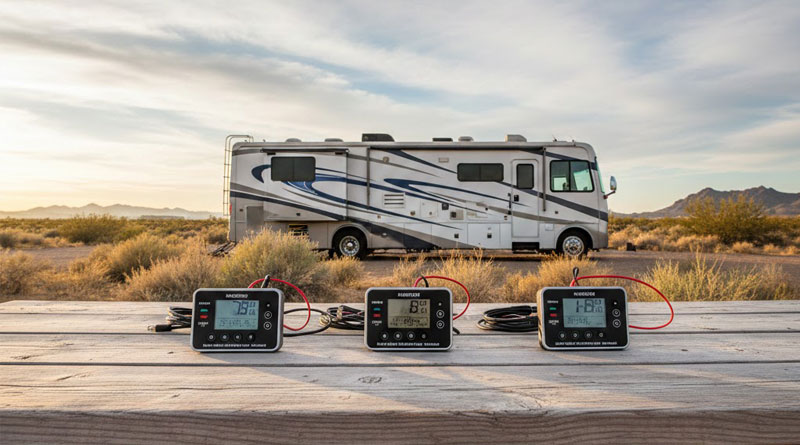
Best Battery Monitors For RV of 2026
A reliable battery monitor acts as the essential dashboard for your RV’s energy heart. From preventing unexpected power outages to maximizing battery lifespan, these devices are indispensable for any RVer. This comprehensive guide will help you navigate the myriad of options available, detailing the key features, technical specifications, and considerations needed to choose the best battery monitor that perfectly suits your specific RV setup and travel demands.
1. ANCEL BM300 Pro Bluetooth Battery Monitor

- Compatibility: 6V/12V/24V lead-acid batteries
- Bluetooth: Version 5.3 for stable, low-power connection
- Waterproof Rating: IP67
- Data Storage: Up to 72 days of historical data
The ANCEL BM300 Pro offers a robust and versatile solution for monitoring the battery health of a wide range of vehicles, including large RVs, trucks, and boats. What truly sets it apart is its expanded compatibility, seamlessly supporting 24V systems alongside the more common 6V and 12V setups. This makes it an ideal upgrade for those with demanding power requirements. Beyond just voltage, the BM300 Pro meticulously tracks cranking and charging system performance.
Ease of use is another significant advantage, with a simple installation process that allows for permanent attachment to your battery. Once installed, real-time data is effortlessly accessible via a smartphone app through its advanced Bluetooth 5.3 connection, which ensures a fast, stable, and energy-efficient link. The device boasts over 99.6% accuracy, thanks to an intelligent chip and precision connector design. Furthermore, built-in reverse connection and short-circuit protection, coupled with an IP67 waterproof rating and fire-resistant ABS shell, enhance safety and durability.
- Pros:
- Wide 6V/12V/24V compatibility
- Highly accurate readings (>99.6%)
- Advanced Bluetooth 5.3 connectivity
- Cons:
- Requires app for data viewing
- Optimal performance in open environment
2. Victron Energy Smart Battery Shunt

- Voltage Range: 6.5V-70V
- Max Current: 500 Amps
- Connectivity: Bluetooth via VictronConnect app
- Smart Integrations: VE.Smart Networking, VRM Remote Management
The Victron Energy Smart Battery Shunt stands out as an all-in-one intelligent battery monitor, delivering comprehensive insights directly to your smartphone. Engineered with precision shunt technology, this device provides a granular view of your battery’s status, including crucial metrics like Current State of Charge, Time Remaining, Voltage, Current, Amp Hours, and even the number of charge cycles. This level of detail empowers RVers to truly understand their power consumption and battery health, enabling smarter energy management and extending battery longevity. Its seamless integration into existing systems makes it an excellent choice for both new installations and retrofits.
What truly elevates the Smart Shunt is its advanced connectivity and integration capabilities. Data is instantly presented in the VictronConnect app. Beyond basic monitoring, it wirelessly shares battery sensor data with other Victron devices via VE.Smart Networking, optimizing charging efficiency across your entire system. For those with more complex setups, connection to a communication center unlocks Victron’s VRM Remote Management and DVCC, providing state-of-the-art system-wide battery control. An auxiliary connection further expands its utility.
- Pros:
- Detailed, real-time in-app insights
- Highly accurate shunt technology
- Seamless smart system integrations
- Cons:
- No built-in display, app-dependent
- Higher cost than basic monitors
3. LiTime 500A Battery Monitor with LCD Screen
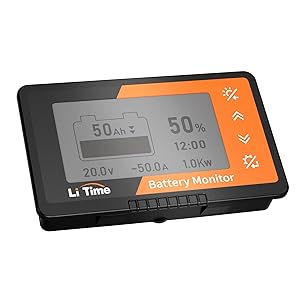
- Voltage Range: 8V-120V
- Current Capacity: 0-500AH battery bank
- Display Type: LCD Backlight Screen
- Alarm Features: Voltage & Capacity alarm with buzzer
The LiTime 500A Battery Monitor offers a robust and user-friendly solution for a wide array of battery systems, ranging from 8V to 120V. This makes it an incredibly versatile choice for RVs, golf carts, motorcycles, and even solar panel setups, accommodating various battery types including Li-ion, LiFePO4, Gel, and AGM with auto-recognition. The monitor provides precise data on battery voltage, current, power, and capacity, along with crucial information like remaining charge/discharge time and percentage. Its clear LCD backlight screen ensures readability even at night.
Beyond its comprehensive data display, the LiTime monitor includes essential safety features such as programmable voltage and capacity alarms. If your battery’s voltage or capacity drops below a preset threshold, the LCD will flash and a buzzer will sound every 10 seconds, providing immediate notification to prevent over-discharge and potential damage. Installation is made straightforward with a shunt holder and clear instructions provided in the manual, ensuring stable placement.
- Pros:
- Wide 8V-120V voltage compatibility
- Clear LCD backlight screen
- Programmable voltage and capacity alarms
- Cons:
- Not waterproof, unsuitable for marine use
- Requires manual setup after connection
4. Victron Energy BMV-712 Smart Battery Monitor

- Voltage Range: 6.5V-70 VDC
- Connectivity: Built-in Bluetooth, VE.Direct for GX devices
- Auxiliary Input: Programmable (temperature, midpoint, 2nd battery voltage)
- Display: Integrated LCD for key metrics
The Victron Energy BMV-712 Smart Battery Monitor is a powerhouse of comprehensive battery management, designed for RVers who demand precise and flexible system oversight. Compatible with battery systems ranging from 6.5 to 70 VDC, this monitor provides an accurate snapshot of your battery’s health, displaying crucial metrics such as State of Charge percentage, voltage, current, energy/time remaining, and more. What truly sets the BMV-712 apart is its dual monitoring capability – not only does it feature a clear integrated display for immediate readouts, but it also boasts built-in Bluetooth communication for wireless monitoring via the VictronConnect app on your smartphone or tablet.
Further enhancing its utility, the BMV-712 includes an innovative additional input that can be programmed for various purposes, such as measuring battery temperature, monitoring midpoint voltage, or even tracking the voltage of a second battery. This flexibility, combined with a programmable relay to control other devices, makes it an incredibly adaptable solution for complex RV power setups. For remote monitoring, it can connect to a GX device (sold separately) via a VE.Direct cable, allowing you to access data and manage your system from anywhere in the world through Victron’s VRM portal.
- Pros:
- Comprehensive battery monitoring
- Dual display and Bluetooth app access
- Programmable auxiliary input and relay
- Cons:
- Installation requires caution and expertise
- GX device for remote monitoring sold separately
5. DROK RV Battery Monitor 12v

- Voltage Range: 10-100V (12V, 24V, 36V, 48V, 60V)
- Battery Types: Lithium, Lead-acid, LiFePO4, NiMH
- Display Type: LCD with backlight
- Additional Feature: Internal temperature gauge (Fahrenheit)
The DROK RV Battery Monitor 12v offers a straightforward and versatile solution for monitoring the battery status across a wide range of applications, from RVs and golf carts to cars and marine vessels. Its broad compatibility with battery types including lithium, lead-acid, LiFePO4, and NiMH, and a voltage range of 10-100V, makes it a highly adaptable choice for diverse power systems. This unit goes beyond basic voltage readings by also functioning as a battery capacity tester, providing a comprehensive overview of your battery’s remaining power. The clear LCD display with a backlight ensures that readings are easily visible in various lighting conditions, making it convenient for day or night use.
One of the distinguishing features of the DROK monitor is its integrated temperature gauge, which displays in Fahrenheit. While it’s important to note that this measures the internal temperature of the meter itself rather than the ambient air or battery temperature directly, it still provides a useful additional data point for overall system awareness. Designed for ease of installation and use, the monitor allows for programmable percentage settings corresponding to specific voltages, giving you customizable control over how battery capacity is displayed. As a default, it’s set for a 12-volt lead-acid battery, but its flexibility makes it suitable for various DIY projects where reliable battery monitoring is essential.
- Pros:
- Wide 10-100V voltage compatibility
- Supports multiple battery chemistries
- Clear LCD display with backlight
- Cons:
- Temperature gauge is internal to meter
- Basic features compared to shunt-based monitors
6. QWORK Battery Monitor Voltmeter Ammeter
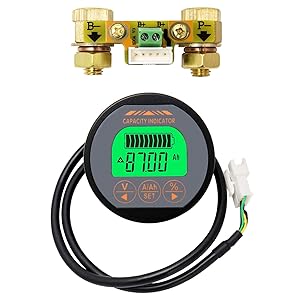
- Voltage Range: 8V-80V
- Current Range: 0-100A
- Display Type: Large backlit LCD
- Data Storage: Automatic storage of last test data
The QWORK Battery Monitor Voltmeter Ammeter offers essential battery status information in a clear and concise format, making it a practical tool for various DC-powered applications including RVs, boats, and electric bikes. This monitor provides high-precision current detection, allowing you to gauge your battery bank’s condition much like a fuel gauge, providing clear notes on its real-time status. The large backlit LCD display is a key advantage, presenting multiple battery metrics simultaneously, such as voltage, current, consumed power, and remaining battery capacity, ensuring readability even in low-light conditions.
Designed for convenience, the QWORK monitor includes an automatic data storage feature, which saves the last testing data when the system is shut off. This allows users to easily review previous performance without needing to manually record information. With a robust voltage range of 8V-80V and a current range of 0-100A, it is compatible with a broad spectrum of battery systems. The inclusion of a 6.5 ft custom cable facilitates flexible installation, enabling you to position the display in an easily accessible location away from the battery itself. Its wide application makes it a versatile and reliable choice for mobile and portable equipment, ensuring you’re always aware of your power reserves.
- Pros:
- High precision current detection
- Large, backlit LCD display
- Automatic data storage
- Cons:
- Lacks advanced smart features (Bluetooth)
- No explicit alarm functionality mentioned
7. Renogy 500A Battery Monitor with Shunt

- Accuracy: 1% measurement accuracy
- Max Current: Up to 500A
- Voltage Range: 10V-120V
- Cable Length: 20ft shielded cable
The Renogy 500A Battery Monitor with Shunt is an indispensable tool for RV owners seeking highly accurate and comprehensive oversight of their battery systems. Utilizing a shunt-type design, this monitor delivers exceptional 1% accuracy in real-time voltage and current draw measurements, ensuring you always have a precise understanding of your power consumption. Its broad compatibility covers a wide range of battery types, including Lead Acid (AGM, GEL), Lithium Iron Phosphate, and Lithium-ion, and it supports systems operating at 12V, 24V, and 48V, making it incredibly versatile for diverse RV setups. This precision and adaptability are crucial for optimizing battery performance and extending their lifespan.
Beyond accurate readings, the Renogy monitor prioritizes battery protection with its high and low capacity alarm functions. Should your battery reach critical voltage levels, the monitor will not only sound an alarm but also flash its backlight and voltage value, providing immediate visual and audible warnings to prevent over-discharge or over-charge. The high-definition backlit display makes it easy to read multiple electronic parameters—including Voltage, Current, Consumed Power, Battery Capacity, and even battery degradation rate—with customizable brightness. Installation is streamlined with a transparent shunt holder and a generous 20ft shielded cable, offering ample flexibility to mount the display at a convenient distance from your battery bank, making it a reliable and user-friendly choice for serious RVers.
- Pros:
- High 1% measurement accuracy
- Wide compatibility with battery types and voltages
- Programmable high/low voltage alarms
- Cons:
- No Bluetooth connectivity
- Requires physical display mounting
How to Choose Battery Monitors For RV
Choosing the right monitor, however, can be daunting with the array of options available. This guide will walk you through everything you need to know to select the perfect battery monitor for your RV, ensuring your power stays on and your adventures remain bright.
Why Do You Need an RV Battery Monitor?
Many RVs come with basic voltage meters that offer a rough estimate of battery charge. However, these are often inaccurate and provide limited information, akin to knowing your car has gas but not how many miles until empty. A dedicated RV battery monitor provides precise data, helping you in several critical ways:
Preventing Stranded Situations
Imagine being boondocking far from civilization only to discover your batteries are dead, leaving you without lights, heat, or the ability to start your generator. A good battery monitor gives you an accurate state of charge and, often, an estimate of remaining runtime, allowing you to conserve power or recharge before it’s too late.
Extending Battery Life
RV batteries, especially deep-cycle ones, have a finite number of charge cycles. Repeatedly discharging them too deeply significantly shortens their lifespan. A monitor helps you avoid excessive discharge, alerting you when your battery capacity drops to a critical level, thereby maximizing its life and saving you money in the long run.
Optimizing Energy Usage
By understanding exactly how much power your appliances are drawing, you can better manage your energy consumption. A monitor showing real-time current draw allows you to identify power-hungry devices and make smart choices about what to run and when, ensuring you stay within your battery’s limits.
Types of RV Battery Monitors
Battery monitors come in various forms, each offering different levels of functionality and precision. Understanding these types is the first step in choosing the right one for your needs.
Simple Voltmeters
These are the most basic and often factory-installed monitors. They measure only voltage, which can be misleading. Battery voltage fluctuates under load and takes time to stabilize after charging or discharging, making it an unreliable indicator of true state of charge. They are best for a quick, general check, but not for precise management.
Shunt-Based Monitors
Considered the gold standard for accuracy, shunt-based monitors measure both voltage and current (amps) flowing in and out of your battery bank. A “shunt” is a low-resistance resistor placed in series with your battery’s negative terminal. By measuring the voltage drop across this shunt, the monitor precisely calculates current flow. This allows it to track amp-hours consumed and returned, providing a highly accurate State of Charge (SoC) percentage, remaining runtime, and other critical data. These are highly recommended for any serious RVer.
Smart/Bluetooth Monitors
Many modern shunt-based monitors now include Bluetooth connectivity. This allows you to monitor all your battery data wirelessly via a smartphone app. These apps often provide more detailed historical data, customizable alarms, and sometimes even integration with other smart devices in your RV’s power system. They offer convenience and a richer user experience.
All-in-One Power Centers
Some high-end RVs and custom builds integrate battery monitoring directly into a central power management system. These systems often provide comprehensive monitoring for multiple battery banks, solar input, generator status, and load management from a single display or app interface. While powerful, they are typically complex and expensive to install.
Key Features to Consider
Once you understand the basic types, delve into the specific features that will impact your monitoring experience.
Accuracy
For true peace of mind and effective battery management, accuracy is paramount. Shunt-based monitors are inherently more accurate than simple voltmeters. Look for models that specify a high level of precision (e.g., 1% or better).
Compatibility (Battery Type and Voltage Range)
Ensure the monitor supports your RV’s battery chemistry (lead-acid, AGM, gel, lithium LiFePO4, etc.) and voltage system (12V, 24V, 48V). Many advanced monitors are universal, but always double-check the specifications.
Display Type and Readability
Do you prefer a dedicated LCD screen or a smartphone app? Some monitors offer both. A clear, backlit display is essential for visibility in various lighting conditions. App-based monitors should have an intuitive interface that presents data clearly.
Data Tracking and Logging
The ability to view historical data (e.g., deepest discharge, average voltage, charge/discharge cycles) is invaluable for understanding trends and optimizing your power usage over time. Some monitors store data for weeks or months, allowing for long-term analysis.
Alarms and Notifications
Programmable high and low voltage alarms, low capacity warnings, and over-current alerts are crucial safety features. These notify you before potential issues become critical, preventing damage to your batteries or unexpected power loss.
Ease of Installation
While basic voltmeters are simple, shunt-based monitors require a bit more wiring. Consider whether you’re comfortable with a DIY installation or if you’ll need professional help. Look for clear instructions and necessary mounting hardware.
Connectivity (Bluetooth, Wired, Remote)
Bluetooth offers convenient wireless monitoring. For more advanced systems, wired connections like VE.Direct (Victron Energy) or compatibility with remote management platforms (like Victron’s VRM) allow for monitoring from anywhere in the world, ideal for full-timers or those wanting to keep an eye on their RV remotely.
Durability and Weather Resistance
Given the challenging environments RVs can encounter, look for monitors with robust construction, especially if any part is exposed to the elements. IP ratings (e.g., IP67 for dust and water resistance) indicate durability.
Understanding Technical Specifications
Familiarize yourself with these terms to fully grasp a monitor’s capabilities:
- Voltage Range (V): The minimum and maximum voltage the monitor can accurately read. Match this to your battery bank’s nominal voltage.
- Current Capacity (A): The maximum continuous current the shunt can handle. Ensure it exceeds your RV’s peak current draw.
- Amp-Hours (Ah): A unit of electrical charge. Monitors track amp-hours consumed and returned to calculate State of Charge.
- State of Charge (SoC): The percentage of energy remaining in your battery, the most crucial metric.
- Depth of Discharge (DoD): How much energy has been removed from a battery. Avoiding deep discharges (e.g., below 50%) is key to battery longevity.
Installation Considerations
Proper installation is vital for accurate readings and safe operation.
DIY vs. Professional
Installing a simple voltmeter is generally easy. Shunt-based monitors require wiring the shunt into the main negative battery cable and running a small data cable to the display. If you’re uncomfortable with electrical work, consult a professional RV technician.
Mounting Location
Choose a location for the display that is easily visible and accessible from your main living area. The shunt should be mounted close to the battery bank, typically on a sturdy, non-conductive surface, and protected from environmental damage.
Wiring
Always follow the manufacturer’s instructions meticulously. Ensure all connections are secure and properly insulated. Incorrect wiring can lead to inaccurate readings, system damage, or even fire hazards.
Budget
Battery monitors range widely in price. Simple voltmeters can be under $30, while advanced shunt-based or smart monitors can cost $150-$400+. Consider your RVing style, battery bank size, and how much detail you genuinely need. Investing in a good monitor can save you significant money in battery replacements and prevent costly disruptions.
Conclusion
Choosing the best battery monitor for your RV is a pivotal decision for ensuring reliable power and prolonging the life of your expensive battery bank. By understanding the different types of monitors, their key features, and essential technical specifications, you can confidently select a device that perfectly aligns with your RV setup and travel aspirations. Whether you opt for a robust shunt-based system with smart app connectivity or a dependable standalone display, a quality battery monitor will empower you with critical insights, transforming potential power anxieties into carefree adventures. Invest wisely, and enjoy the peace of mind that comes with knowing your RV’s heart is always in optimal condition.