Best RV Propane Detectors of 2026
Ensuring RV safety is paramount, and a reliable propane detector is essential. Propane leaks pose serious risks, from fire hazards to health concerns, making early detection critical. This guide explores the best RV propane detectors on the market, helping you choose wisely. Discover top models offering accuracy, durability, and user-friendly features for ultimate peace of mind on the road.
1. Bestfire Propane Tank Gauge & Leak Detector

- Compatibility: 5-40 lb propane tanks
- Connection Type: QCC1/Type 1
- Monitoring: Color-coded dial (real-time)
- Material: Heavy-duty brass construction
The Bestfire Propane Tank Gauge with Leak Detector offers a practical solution for monitoring your propane levels and ensuring safety across various applications. Designed for universal compatibility with 5-40 lb tanks using QCC1/Type 1 connections, this gauge is perfect for BBQ grills, RVs, camping stoves, and heaters. Its color-coded dial provides instant, clear readings—green for full, yellow for low, and red for empty—eliminating the guesswork of when you’ll run out of gas. Installation is remarkably simple and tool-free, thanks to its easy-handwheel design, making it a convenient accessory for any setup.
Beyond level indication, the built-in leak detection feature automatically restricts propane flow if a leak is detected, significantly enhancing safety and offering crucial peace of mind. Crafted from solid brass, the gauge is built to withstand corrosion, abrasion, and extreme temperatures, promising long-lasting durability. It even includes a dust cover to protect the dial for sustained accuracy. While installation requires ensuring the tank’s gasket is intact and mounting horizontally for a secure seal, these minor steps ensure optimal performance and safety.
- Pros:
- Universal compatibility (5-40lb tanks, QCC1/Type 1)
- Instant, clear propane level readings (color-coded)
- Easy, tool-free installation
- Cons:
- Requires specific installation attention (gasket, horizontal mount)
- Accuracy dependent on tank pressure
2. DOZYANT Propane Tank Gauge & Leak Detector

- Quantity: Set of 2
- Compatibility: 5-40 lb propane tanks
- Connection Type: QCC1 / Type 1
- Monitoring: Color-coded dial
The DOZYANT Propane Tank Gauge and Leak Detector comes in a convenient 2-pack, offering excellent value and versatility for anyone using propane appliances. These gauges are universally compatible with all QCC1/Type 1 connections and suitable for 5 lb to 40 lb propane tanks, making them ideal for BBQ grills, RV campers, heaters, and various other propane-powered gear. Constructed from high-quality materials, they ensure a secure, air-tight connection to your tank, minimizing the risk of leaks and maximizing safety.
A key benefit is the color-coded dial, which allows for quick, at-a-glance monitoring of your fuel level, so you’ll know precisely when your propane is running low without the hassle of removing or shaking the tank. Installation is remarkably simple and tool-free, featuring a handwheel grip for easy tightening. This makes the DOZYANT gauge a practical and reliable accessory for effortless fuel management and leak detection, enhancing safety and convenience for all your outdoor and RV adventures.
- Pros:
- Comes in a convenient 2-pack
- Universal compatibility with QCC1/Type 1 connections
- Ensures secure, air-tight connection
- Cons:
- Dial only visible manually
- Pressure-based reading (can vary with temperature)
3. Camco RV Propane Gauge and Leak Detector

- Connection Type: Type 1
- Compatibility: DOT propane cylinders (post-1995 with ACME/OPD)
- Safety Features: Excess flow protection, thermal protection
- Operation: Reads levels when propane is flowing
The Camco RV Propane Gauge and Leak Detector is a robust and essential safety device for any RV, boat, or gas grill setup. Featuring a standard Type 1 connection, it’s designed to fit DOT propane cylinders manufactured after 1995 that utilize the ACME/OPD connection. This gauge allows you to quickly see at a glance when your propane pressure level is low, helping you avoid unexpected run-outs during cooking or heating. It’s a straightforward tool focused on practicality and core safety.
Beyond just displaying levels, the Camco unit provides crucial safety features: it includes excess flow protection, which automatically restricts gas flow in the event of a broken gas line, and thermal protection for added security in case of fire. It’s important to note that the gauge begins reading levels once propane is flowing, rather than providing a static tank pressure reading. This functional design makes it a reliable choice for monitoring propane usage and enhancing safety with essential protective mechanisms.
- Pros:
- Standard Type 1 connection for wide use
- Built-in excess flow protection
- Integrated thermal protection
- Cons:
- Does not read levels instantly (only when propane flows)
- No digital display for precise readings
4. Smarter Living WiFi Gas Alarm Leak Detector

- Compliance: UL 1484 compliant
- Detection Type: Natural Gas, Propane, Methane, Butane, LPG, LNG
- Connectivity: 2.4GHz WiFi (Smart Life/Tuya App)
- Alarm: 70dB audible, instant phone alerts
The Smarter Living WiFi Gas Alarm Leak Detector offers advanced, connected protection against a range of combustible gases, including propane, methane, and natural gas. UL 1484 compliant, this detector provides professional-grade reliability for your RV or home. It connects seamlessly via the Smart Life or Tuya app, delivering real-time gas concentration readings, history logs, and instant phone alerts, even when you’re away. An on-device 70dB audible alarm ensures you’re warned immediately, regardless of WiFi connectivity, with an alarm trigger point set proactively at 7% LEL for enhanced safety.
Setting up this smart detector is straightforward, thanks to a specialized Bluetooth-assisted mode for quick and error-free connection to your 2.4GHz WiFi router. Crucially, it offers full functionality and app notifications without requiring a subscription, providing ongoing peace of mind at no extra cost. The plug-in design ensures continuous power, making it a reliable guardian against hazardous gas leaks. For those seeking modern safety with remote monitoring and comprehensive gas detection capabilities in their RV, this Smarter Living detector is an excellent choice.
- Pros:
- UL 1484 compliant for high reliability
- Detects multiple combustible gases (Propane, Methane, etc.)
- Instant phone alerts and local 70dB alarm
- Cons:
- Requires a stable 2.4GHz WiFi connection
- Plug-in design (not battery-operated)
5. PANGAEA RV CO & Propane Dual Gas Detector PRC2000
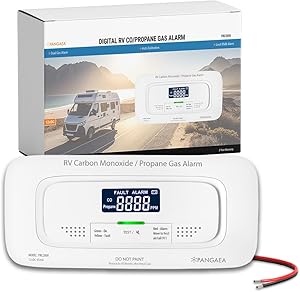
- Detection: Carbon Monoxide (CO) & Propane (LPG)
- Power: Hard-wired DC 12V
- Display: Large LCD screen
- Alarm: 85dB loud alarm
The PANGAEA RV Carbon Monoxide & Propane Dual Gas Detector PRC2000 provides comprehensive safety for your RV or motorhome by efficiently detecting both CO and LPG. Its hard-wired DC 12V design ensures continuous power, making it a reliable fixture in your vehicle. The large, easy-to-read LCD screen clearly displays gas concentration readings and device status, keeping you informed of your air quality in real-time. This dual-threat detection system simplifies your safety setup by covering two critical gas hazards in one unit.
Equipped with a multi-color LED indicator for quick visual alerts and a powerful 85dB loud alarm, the PRC2000 ensures you are instantly notified of dangerous gas levels, protecting occupants and pets. Installation is quick and straightforward, designed to easily replace common existing RV detectors like MTI Safe-T-Alert and CCI models. Meeting UL1484, UL2034, and CE safety standards, this detector offers peace of mind with its reliable performance and adherence to strict regulations, making it an essential upgrade for any RV enthusiast.
- Pros:
- Dual Carbon Monoxide and Propane detection
- Clear LCD for real-time readings
- Multi-color LED visual alerts
- Cons:
- Hard-wired DC 12V installation
- Flush mount requires a specific cut-out
6. Nuleto RV Dual LP/CO Alarm Detector

- Detection: Carbon Monoxide (CO) & Propane (LP)
- Sensors: High-sensitivity semiconductors & electrochemical
- Display: Digital screen for concentration
- Certification: UL Listed
The Nuleto RV Dual LP/CO Alarm provides essential 2-in-1 protection for your RV, featuring independent detection probes to simultaneously monitor both carbon monoxide and propane gases. This comprehensive design ensures that you receive early warnings, giving you ample time to react and prevent potential hazards, thus safeguarding your family and property during your travels. The detector is equipped with UL Listed high-sensitivity semiconductors and high-precision electrochemical sensors, guaranteeing excellent detection accuracy and reliability.
Installation is notably user-friendly, utilizing lever nut connectors that eliminate the need for tape or complex wiring, making it ideal for first-time installers or for replacing existing units. Once powered, it automatically warms up and begins working without any setup. A clear digital display shows leak concentrations, with an alarm sounding quickly (0.5-2s response) if CO exceeds 150 PPM or propane reaches 5% LEL. This combination of easy installation, rapid response, and certified sensors makes the Nuleto alarm a highly recommended safety device for RV camping.
- Pros:
- 2-in-1 CO and Propane dual detection
- Independent probes for simultaneous monitoring
- Quick response time (0.5-2s)
- Cons:
- Requires 0.3-inch recess for flush mounting
- Hard-wired power (no battery option)
7. PANGAEA Digital RV Propane Gas Detector

- Detection: Propane gas only
- Sensor Type: Highly sensitive semiconductor
- Power: DC 12V
- Display: Digital screen (real-time, error codes)
The PANGAEA Digital RV Propane Gas Detector is engineered to provide fast and accurate detection of propane leaks within your RV, trailer, or motorhome. Utilizing highly sensitive semiconductor sensors, this detector offers quicker response times to gas exposure, giving you crucial moments to react. Its real-time digital display provides clear concentration readings and error codes, making it an excellent upgrade or replacement for older models, allowing you to monitor your environment with confidence.
Safety is paramount with this detector, which features a loud 85dB audible alarm that ensures you’re alerted promptly, even during the night. A convenient test/reset button allows for easy functionality checks and silencing unwanted triggers. UL1484 tested and certified, this unit ensures reliable performance, offering peace of mind. Designed for both surface and flush mounting, its sleek, modern aesthetic integrates seamlessly into any RV interior, occupying minimal space while providing critical protection against the dangers of propane gas.
- Pros:
- Highly responsive semiconductor sensor
- Real-time digital display with error codes
- Loud 85dB audible alarmy
- Cons:
- Detects propane only (no CO detection)
- Hard-wired DC 12V installation
How to Choose RV Propane Detectors
Recreational vehicles offer unparalleled freedom and adventure, but with the comforts of home comes the responsibility of ensuring safety, particularly concerning propane gas. Propane is a versatile fuel used extensively in RVs for cooking, heating, and refrigeration, making it an indispensable part of the RV lifestyle. However, propane leaks pose significant dangers, including fire, explosion, and asphyxiation, emphasizing the critical need for reliable detection. Unlike carbon monoxide, which is odorless, colorless, and tasteless, propane also has an added odorant (mercaptan) for detection, but a detector acts as your primary, fail-safe alarm.
Understanding the distinct threats of both propane and carbon monoxide is crucial; while a propane detector signals a flammable gas leak, a CO detector warns of a toxic byproduct of combustion. For comprehensive safety, RV owners ideally need both. Many modern RVs come equipped with factory-installed detectors, but these have a limited lifespan and often require replacement every 5-7 years, making an informed choice for your next detector paramount.
Understanding Different Types of RV Propane Detectors
Choosing the right propane detector for your RV involves understanding the various types available, each with distinct advantages and applications. These can broadly be categorized into ambient gas detectors, which monitor the air within your RV, and propane tank gauges/leak detectors, which monitor the gas supply at the source.
Ambient Gas Detectors
These detectors are designed to sense propane gas that has leaked into the living space of your RV. They typically feature sensors that react to the presence of propane in the air.
Wired Detectors (12V DC)
The most common type found in RVs, these detectors are hard-wired into your RV’s 12-volt DC power system. Their main advantage is continuous power, meaning you don’t have to worry about batteries dying. This constant monitoring ensures uninterrupted protection. However, installation can be more complex, often requiring professional help, and if not properly managed, they can contribute to your RV’s parasitic battery drain when dry camping. Their placement is usually fixed, typically near the floor where propane, being heavier than air, tends to accumulate.
Wireless/Battery-Operated Detectors
Offering greater flexibility in placement and easier installation, battery-operated propane detectors are a popular choice for those who prefer not to hardwire. Their primary advantage is portability and ease of setup, making them suitable for temporary use or as supplementary detectors. The main drawback is the need for regular battery checks and replacements, as a dead battery renders the detector useless. Some models might also feature less sophisticated sensors compared to their wired counterparts, but technology is rapidly improving in this segment.
Smart/WiFi-Enabled Detectors
Embracing modern technology, smart propane detectors connect to your RV’s WiFi network, providing remote monitoring and alerts directly to your smartphone. This means you can receive notifications even when you’re away from your RV, offering an extra layer of peace of mind. Many also integrate with smart home systems, allowing for comprehensive control. While highly convenient, they rely on a stable WiFi connection and typically come at a higher price point. Subscription services for advanced features like SMS or phone call alerts might also be an additional cost.
Dual LP/CO Detectors
Perhaps the most recommended type for RV owners, dual LP/CO detectors combine both propane and carbon monoxide detection into a single unit. Given that many RV appliances use propane and can also produce carbon monoxide as a byproduct of incomplete combustion, having both detection capabilities in one device is highly advantageous. This streamlines installation, reduces clutter, and provides comprehensive protection against the two most critical gas-related threats in an RV. They are typically hard-wired 12V DC units and are an excellent investment in all-around RV safety.
Propane Tank Gauges/Leak Detectors (Inline)
These devices are different from ambient detectors as they monitor the propane supply directly at the tank connection rather than sensing gas in the air.
Pressure Gauges
Inline pressure gauges attach directly to your propane tank valve (e.g., QCC1/Type 1 connection) and display the pressure inside the tank, often with a color-coded dial (green for full, red for empty). They offer a quick and easy way to estimate your propane level without disconnecting the tank. However, they measure pressure, not actual volume, and pressure can fluctuate with ambient temperature, leading to potentially inaccurate readings, especially in cold weather. They are excellent for a quick visual check but shouldn’t be your sole method of leak detection or fuel management.
Leak Detection Adapters
Some inline devices offer simple leak detection by incorporating a mechanism that restricts gas flow if a significant leak is detected at the tank connection. While useful for identifying leaks right at the source, they don’t provide continuous ambient air monitoring within the RV’s living space. They are best used as a first line of defense at the tank connection, complementing an indoor ambient gas detector.
Key Features to Look for in an RV Propane Detector
When selecting a propane detector, several features are crucial for ensuring optimal safety and functionality in your RV. Prioritizing these aspects will help you choose a device that offers reliable protection.
Sensitivity and Accuracy
A good detector must be highly sensitive to propane and provide accurate readings. Look for models that specify their detection threshold, often expressed as a percentage of the Lower Explosive Limit (LEL). Propane’s LEL is about 2.1%, so a detector that alarms well below this (e.g., 5-10% of LEL) provides an earlier warning. Fast response times, typically within seconds, are also critical for minimizing exposure and allowing prompt action.
Alarm Features
The alarm itself needs to be effective. An audible alarm should be loud enough to wake you, usually 85dB or higher. Visual indicators, such as flashing LEDs or a clear digital display, are also important for quickly understanding the situation and the gas concentration. For smart detectors, remote notifications via an app are a huge advantage, alerting you to potential dangers even when you’re away from your RV.
Power Source
Consider whether a 12V DC hard-wired or battery-operated unit best suits your RV. Hard-wired detectors offer continuous power but require proper installation and can contribute to battery drain. Battery-operated units are easier to install but demand regular battery checks. Some newer models may offer USB power or a combination of power sources for added flexibility.
Durability and Construction
RVs face varying environmental conditions, so your detector needs to be robust. Look for durable materials resistant to vibration, temperature fluctuations, and humidity. For inline tank gauges, brass construction is preferred for its corrosion resistance. A well-built casing for ambient detectors protects internal components and ensures longevity.
Certifications and Standards
Always check for recognized safety certifications such as UL 1484 (for LP gas detectors), UL 2034 (for CO detectors), CSA, or CE. These certifications indicate that the product has undergone rigorous testing and meets strict safety and performance standards, ensuring its reliability and effectiveness.
Ease of Installation and Maintenance
Consider how easy the detector is to install. Hard-wired units may require some electrical know-how, while plug-and-play or battery-operated options are generally simpler. Features like a test/reset button are vital for routine maintenance, allowing you to quickly verify functionality. Also, be aware of the sensor’s lifespan; most propane detectors need replacement every 5-7 years, regardless of use.
Additional Considerations
Some advanced detectors may offer temperature compensation to improve accuracy in varying conditions or resistance to humidity, which can otherwise trigger false alarms. Compatibility with existing RV systems, such as your RV’s central alarm panel, might also be a desirable feature for a fully integrated safety setup.
Installation and Placement Best Practices
Proper installation and strategic placement are as critical as the quality of the detector itself. Given that propane is heavier than air, it settles near the floor. Therefore, ambient propane detectors should always be mounted low to the ground, typically within 6-18 inches of the floor, and near potential leak sources like propane appliances (furnace, water heater, stove, refrigerator) and the main propane line. Avoid placing detectors directly in front of vents, windows, or doors, which could interfere with accurate air sampling. For hard-wired units, ensure proper wiring connections and fuse protection to prevent electrical issues.
Regular maintenance is key to the long-term effectiveness of your detector. Test the unit monthly using the built-in test button to confirm the alarm is functioning. Keep the detector free from dust and debris, as accumulated grime can impede sensor performance or trigger false alarms. Most importantly, be mindful of the detector’s expiration date. Sensors degrade over time, and even if a unit appears to be working, its detection capabilities may diminish. Replace your propane detector according to the manufacturer’s recommendations, usually every 5-7 years.
Troubleshooting Common Issues
Even the best propane detectors can occasionally present issues. False alarms are a common concern and can be triggered by dust, strong cleaning agents, aerosols, high humidity, or even residual fumes after cooking. If a false alarm occurs, ventilate the RV thoroughly and observe if the alarm resets. If it persists, it might indicate a genuine leak. Detector malfunctions, such as continuous beeping without gas presence or failure to respond to the test button, could signal an end-of-life sensor, low battery, or a wiring issue if hard-wired. Consult your user manual for specific troubleshooting steps.
In the event of an actual alarm, act swiftly and calmly. Turn off all propane appliances, open windows and doors to ventilate the RV, and evacuate all occupants immediately. Do not use any electrical switches, phones, or ignition sources until the area has been declared safe and the source of the leak identified and repaired by a qualified professional. Knowing what to do in an emergency can make all the difference.
Conclusion
Choosing the best RV propane detector is a fundamental step in ensuring the safety and enjoyment of your recreational vehicle. From understanding the nuances of ambient versus inline detectors to prioritizing key features like sensitivity, alarm type, and certifications, making an informed decision is crucial. Remember the importance of proper installation and diligent maintenance, including regular testing and timely replacement. By equipping your RV with a reliable propane detector and adhering to safety protocols, you can confidently embark on countless adventures, secure in the knowledge that you’ve taken essential steps to protect yourself and your loved ones from potential gas hazards. Your peace of mind on the road is truly priceless.