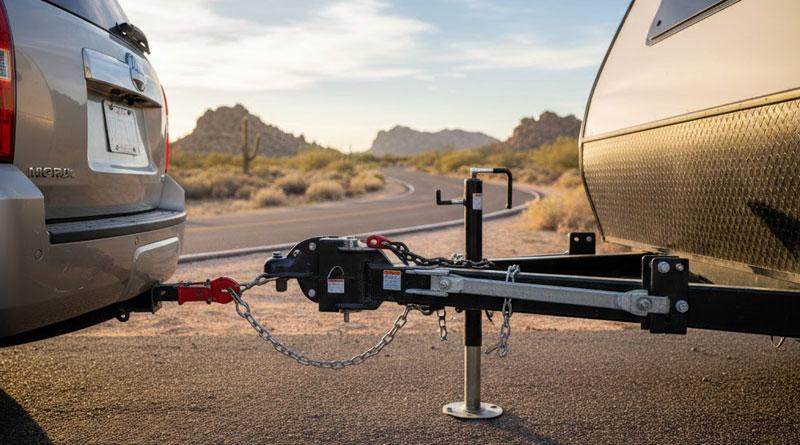
Best Weight Distribution Hitches For Travel Trailer of 2026
Ensuring a safe and stable towing experience for your travel trailer is paramount, and a high-quality weight distribution hitch is a non-negotiable component. These essential systems effectively redistribute the trailer’s tongue weight across your tow vehicle’s axles, preventing sag, improving steering, and significantly reducing sway. Choosing the right hitch transforms stressful journeys into smooth, controlled travels.
1. Camco Eaz-Lift Elite 1,000lb Weight Distribution Hitch Kit

- Tongue Weight Capacity: Up to 1,200 lb
- Gross Trailer Weight: Up to 12,000 lb
- Sway Control: Manually adjustable external system
- Setup: Pre-installed hitch ball and sway control ball
The Camco Eaz-Lift Elite 1,000lb Weight Distribution Hitch Kit stands out for its readiness to tow right out of the box, thanks to pre-installed and torqued hitch and sway control balls. This feature significantly streamlines the installation process, getting you on the road faster. It’s designed to improve towing stability and safety by effectively distributing trailer weight, which helps in maintaining better control and reducing vehicle sag.
The inclusion of a manually adjustable sway control system allows for fine-tuning resistance to match varying road conditions, and it can be easily disengaged when not needed, offering flexibility. With robust capacity ratings for both tongue and gross trailer weight, alongside universal spring bars that mount interchangeably, this kit offers a dependable solution for a smoother and safer towing experience.
- Pros:
- Pre-installed components save installation time
- Manually adjustable sway control for customization
- High capacity ratings for various trailers
- Cons:
- Manual sway control requires adjustment
- External sway control can be less seamless than integrated
- Some users might prefer an automatic system
2. Equal-i-zer 4-point Sway Control Hitch

- Trailer Weight Rating: 12,000 lbs
- Tongue Weight Rating: 1,200 lbs
- Sway Control: Integrated 4-point system
- Compatibility: Works with virtually all bumper-pull trailers
The Equal-i-zer 4-point Sway Control Hitch is renowned for its superior integrated sway control, offering the highest level of resistance against trailer sway attempts on the market. Its unique design doesn’t just manage sway; it proactively works to prevent it by providing constant sway control and effective weight distribution. This combination leads to a noticeably safer and more comfortable towing experience, reducing driver fatigue and increasing confidence.
By effectively transferring trailer tongue weight to all axles, the Equal-i-zer helps keep the front of the tow vehicle firmly on the road, improving steering and braking performance. It’s engineered for broad compatibility, making it suitable for a wide range of bumper-pull trailers, including those with surge brakes. While the hitch ball isn’t included, its comprehensive safety benefits make it a top choice for serious towers.
- Pros:
- Exceptional 4-point integrated sway control
- Improved steering and braking safety
- Broad compatibility with various trailer types
- Cons:
- Hitch ball must be purchased separately
- Potentially higher upfront cost
- Installation might be more involved than basic models
3. Husky 31423 Round Bar Weight Distribution Hitch

- Tongue Weight Range: 801-1,200 pounds
- Gross Trailer Weight: 12,000 pounds
- Height Adjustment: 8 inches total (5-5/8 inch rise, 2-3/8 inch drop)
- Sway Control Platform: Built-in dual sway control platform
The Husky 31423 Round Bar Weight Distribution Hitch is designed with user-friendly installation in mind, featuring a hitch head that provides easy access to the hitch ball shank. This thoughtful design minimizes setup time, allowing you to focus more on your journey. The durable black polyester finish offers excellent resistance against rust and corrosion, ensuring the hitch remains robust even in challenging outdoor conditions.
Its versatility is a key highlight, with interchangeable spring bars that can be mounted on either side of the hitch head, and the ability to accept different spring bar capacities. The built-in dual sway control platform is a convenient addition, though balls are not included and must be purchased separately. With its sturdy construction and adaptable features, this Husky hitch delivers reliable weight distribution for a smoother tow.
- Pros:
- Easy installation with accessible hitch ball shank
- Durable black polyester finish resists corrosion
- Interchangeable spring bars for versatility
- Cons:
- Hitch balls are not included
- Sway control is a platform, not an integrated system
- Requires a 1-1/4″ shank on the trailer ball
4. VEOVR Weight Distribution Hitch with Sway Control

- Tongue Weight Capacity: 1,000 lbs
- Construction Material: High-strength hardened steel
- Sway Control: 4-point swivel control
- Coating: Double-layer black electroplating
The VEOVR Weight Distribution Hitch offers a blend of robust construction and advanced sway control for enhanced towing safety. Crafted from high-strength hardened steel, its components are built for long-term durability, ensuring reliability even in harsh outdoor environments. A standout feature is its 4-point swivel control, which actively limits lateral movement during towing, promoting a remarkably stable and shake-free ride, even when reversing or turning.
This hitch excels at weight distribution, effectively transferring trailer tongue weight across the vehicle and trailer axles to alleviate stress on the tow vehicle’s bumper, improving overall maneuverability. The double-layer black electroplating provides superior wear and rust resistance, extending the hitch’s lifespan. Furthermore, VEVOR includes a pry bar tool, making installation and precise adjustments surprisingly quick and straightforward for users.
- Pros:
- Sturdy, high-strength hardened steel construction
- Effective 4-point swivel control enhances stability
- Excellent wear and rust resistance with double-layer coating
- Cons:
- 1,000 lbs tongue weight might be lower than some competitors
- Brand might be less recognized than established names
- Specific design might require careful initial setup
5. Reese 49912 Pro Round Bar Weight Distribution Hitch

- Capacity: 8,000 lbs GTW
- Hitch Ball: Preinstalled 2-5/16-inch
- Shank: 8.5-inch deep drop shank included
- Trailer Frame Fit: Up to 7-inch trailer frames (no-drill clamp-on)
The Reese 49912 Pro Round Bar Weight Distribution Hitch is engineered to deliver enhanced stability and ride control by effectively distributing weight and minimizing trailer sway. This comprehensive system comes ready with a preinstalled 2-5/16-inch hitch ball and an 8.5-inch deep drop shank, simplifying the initial setup. Its construction features a high-strength steel head and welded hitch bar, ensuring robust durability for long-term towing reliability.
The tapered spring bars are key to its superior ride comfort, providing constant weight distribution over the axles. Designed for convenience, the no-drill, clamp-on brackets fit seamlessly onto trailer frames up to 7 inches, making it an ideal accessory for various RVs and campers. This hitch combines ease of installation with dependable performance for a safer, more comfortable journey.
- Pros:
- Preinstalled hitch ball and included drop shank
- Durable high-strength steel construction
- Tapered spring bars for superior ride comfort
- Cons:
- 8,000 lbs capacity might be lower for heavier trailers
- Clamp-on brackets may not suit all preferences
- Specific drop shank might not be universally ideal
6. CURT 17063 Round Bar Weight Distribution Hitch

- Gross Trailer Weight: 10,000 to 14,000 lbs
- Tongue Weight: 1,000 to 1,400 lbs
- Sway Control: Integrated bar included
- Lubrication: Integrated system with grease zerks
The CURT 17063 Round Bar Weight Distribution Hitch offers a robust solution for leveling your tow and improving control, especially for heavier trailers. Its impressive capacity, supporting up to 14,000 lbs gross trailer weight and 1,400 lbs tongue weight, makes it suitable for a wide range of applications. A standout feature is the integrated lubrication system, with easy-access grease zerk fittings, ensuring continuous lubrication for smooth and quiet towing performance.
This hitch also includes an integrated trailer sway control bar, providing an all-in-one solution for enhanced stability. Constructed with a fabricated head and forged steel spring bars, it promises reliable strength and durability. The highly adjustable 2-inch shank and pre-torqued 2-5/16-inch trailer ball ensure standard fitment and a quick setup, while the carbide black powder coat finish offers excellent corrosion resistance for long-lasting use.
- Pros:
- High gross trailer weight and tongue weight capacity
- Integrated lubrication system for quiet operation
- Includes pre-torqued hitch ball for convenience
- Cons:
- Round bar design may not be preferred by all
- Integrated sway control bar can be less aggressive than 4-point systems
- Can be quite heavy due to robust construction
7. Fastway Connect™ Weight Distribution Hitch

- Max Tongue Weight: 1,000 lb
- Max Trailer Weight: 10,000 lb
- Hitch Ball: 2-5/16” pre-installed
- Shank: Standard shank with 3″ drop and 7″ rise included
The Fastway Connect™ Weight Distribution Hitch is celebrated for its straightforward setup and easy adjustments, making it a favorite for those seeking simplicity without sacrificing performance. Its hardened steel chains connect the hitch arms to the trailer frame, providing effective load distribution for improved steering, braking, and overall vehicle control. Adjusting weight distribution is quick and intuitive—simply change which link of the chain attaches to the trailer frame hook.
This hitch’s time-tested design, coupled with round bar arms, ensures improved towing stability and a safer tow experience, reducing stressful driving situations. Universal compatibility means it easily installs on a wide array of bumper-pull trailers, including RVs, cargo, and utility trailers, without requiring any frame drilling. With a pre-installed hitch ball and versatile shank included, the Fastway Connect™ offers a comprehensive and user-friendly solution.
- Pros:
- Fast and easy adjustments with chain links
- Includes pre-installed hitch ball and standard shank
- Universal compatibility with no frame drilling required
- Cons:
- Chain-based system might feel less rigid than other types
- 1,000 lb max tongue weight may be limiting for some
- Sway control is inherent, not a separate adjustable component
How to Choose Weight Distribution Hitches For Travel Trailer
Embarking on a journey with a travel trailer offers unparalleled freedom and adventure, but it also comes with the responsibility of ensuring a safe and stable towing experience. One of the most critical components for achieving this is a weight distribution hitch. These ingenious devices don’t just connect your trailer to your tow vehicle; they fundamentally alter the dynamics of your towing setup, turning potentially hazardous trips into smooth, controlled travels. Understanding how to choose the best weight distribution hitch for your specific travel trailer is not merely about convenience; it’s about paramount safety for you, your passengers, and others on the road.
Understanding Weight Distribution Hitches
At its core, a weight distribution hitch is a specialized towing system designed to level the load of your travel trailer by redistributing a portion of its tongue weight from the rear axle of your tow vehicle to all axles of the vehicle-trailer combination. When a heavy trailer is attached without a weight distribution system, it can cause the rear of the tow vehicle to sag, lifting the front end. This “nose-up” posture reduces the effective steering and braking capabilities of the front wheels, diminishes traction, and makes the setup more susceptible to trailer sway.
A weight distribution hitch, typically consisting of a hitch head, spring bars, and frame brackets, uses leverage to apply upward force to the trailer tongue, which in turn lifts the rear of the tow vehicle and presses down on the front. This action restores balance, optimizes tire contact with the road, and enhances overall stability. The result is improved handling, better braking, reduced porpoising (bouncing), and a significant decrease in dangerous trailer sway, making your towing experience safer and less fatiguing.
Key Factors to Consider When Choosing
Selecting the right weight distribution hitch requires careful consideration of several factors unique to your travel trailer and tow vehicle. Rushing this decision can compromise safety and lead to an uncomfortable towing experience. Here’s a detailed look at what you need to assess:
1. Your Trailer’s Gross Trailer Weight (GTW) and Tongue Weight (TW)
This is arguably the most crucial factor. Every weight distribution hitch has specific capacity ratings for both Gross Trailer Weight (GTW) and Tongue Weight (TW). The GTW is the total weight of your fully loaded trailer, and the TW is the downward force exerted by the trailer coupler onto the hitch ball. You must select a hitch that matches or exceeds your trailer’s actual loaded GTW and TW. Overloading a hitch can lead to failure and dangerous towing conditions.
To find these numbers, consult your trailer’s manual or manufacturer’s specifications. For TW, it’s best to measure it with the trailer loaded for travel using a tongue weight scale, as it can vary. Ideally, your trailer’s tongue weight should be between 10-15% of its GTW for optimal stability. Ensure the hitch you choose has a TW range that comfortably accommodates your trailer’s actual tongue weight. Always prioritize safety margins; never choose a hitch with a capacity just barely meeting your needs.
2. Type of Sway Control
Sway control is often integrated into weight distribution hitches, or available as an add-on. Its primary function is to dampen or eliminate side-to-side movement of the trailer, which can be caused by wind, passing vehicles, or uneven roads. There are several types:
- Friction Sway Control: These are typically add-on bars that connect the hitch ball to a bracket on the trailer frame. They work by creating friction, resisting lateral movement. While effective for lighter trailers and occasional sway, they must be disengaged in icy or wet conditions and when backing up.
- Cam-Style Sway Control: Often integrated, these systems use cams to hold the spring bars in place, providing consistent friction. They are generally more effective than basic friction types and often don’t need to be disengaged for backing up.
- Integrated 4-Point Sway Control: Considered the most effective, these systems build sway control directly into the hitch head and spring bar connections. They provide constant, active resistance to sway from four points, offering superior stability in challenging conditions. They are ideal for larger travel trailers and frequent towing.
For larger or heavier travel trailers, an integrated or 4-point sway control system is highly recommended for maximum safety and peace of mind.
3. Hitch Type: Round Bar vs. Trunnion Bar
Weight distribution hitches primarily come in two spring bar designs:
- Round Bar: These are typically more common and often more affordable. They use round spring bars that fit into sockets in the hitch head. They can sometimes hang lower, potentially reducing ground clearance, particularly on uneven terrain or steep driveways.
- Trunnion Bar: These bars insert horizontally into the sides of the hitch head. They generally offer better ground clearance compared to round bar designs, making them a preferred choice for trailers that might encounter varied terrain. Trunnion bar hitches are often associated with higher capacities and more robust sway control systems.
Consider your trailer’s clearance needs and the types of roads you’ll be traveling when making this choice. For most travel trailer owners, either type can work, but trunnion bars offer a slight advantage in clearance.
4. Ease of Installation and Adjustment
While a professional installation is always an option, many weight distribution hitches are designed for DIY installation. Look for models with clear instructions and readily accessible components. Features like pre-installed hitch balls, easily adjustable spring bar mounts, or included tools (like a pry bar) can significantly reduce setup time and frustration.
Adjustment is also key. Your hitch will need to be properly adjusted to your specific tow vehicle and trailer combination. This involves leveling the trailer and tow vehicle and ensuring correct tension on the spring bars. Hitches with intuitive adjustment mechanisms, such as easily changeable chain links or simple bolt adjustments, can make this process less daunting for new users.
5. Hitch Ball and Shank Included
Some weight distribution hitches come complete with a pre-installed hitch ball and the necessary hitch shank, which slides into your receiver. Others require you to purchase these components separately. While separate purchases offer customization, an all-inclusive kit saves time, ensures compatibility, and often provides better value. Always verify the ball size (most commonly 2-5/16 inches for travel trailers) and the shank’s drop/rise range to ensure it matches your tow vehicle’s receiver height and trailer coupler height for level towing.
6. Build Quality and Durability
A weight distribution hitch is a significant safety device, so its construction quality is paramount. Look for hitches made from high-strength steel with robust welds. Protective coatings, such as powder coats or electroplating, are essential for resisting rust and corrosion, especially if you tow in varying climates or near saltwater. Durable materials ensure the hitch can withstand the constant stresses of towing over many years.
7. Budget
Weight distribution hitches vary widely in price, from a few hundred dollars to over a thousand. While it’s tempting to opt for the cheapest option, compromising on a safety-critical component is never advisable. Factor in the total cost, including any necessary accessories (like hitch balls, specific tools, or additional sway control), and prioritize features that directly contribute to safety and performance, such as integrated sway control for larger trailers. View it as an investment in your safety and comfort on the road.
Installation and Maintenance Tips
Once you’ve chosen your ideal weight distribution hitch, proper installation and ongoing maintenance are crucial for its performance and longevity. Always follow the manufacturer’s instructions meticulously. This typically involves ensuring your trailer and tow vehicle are level, setting the correct number of chain links or bar tension, and properly torquing all bolts. After initial installation, recheck all connections and adjustments after your first few trips.
Regular maintenance includes inspecting for any signs of wear, damage, or corrosion. Keep moving parts lubricated as per the manufacturer’s recommendations; some hitches have integrated lubrication systems for convenience. Clean the hitch components periodically to remove dirt and grime, especially after towing in dusty or muddy conditions. Proper care will ensure your hitch performs reliably for many adventures to come.
Common Mistakes to Avoid
Even with the best hitch, common mistakes can undermine its effectiveness:
- Incorrect Capacity Matching: Using a hitch with insufficient capacity for your trailer’s actual loaded weight is extremely dangerous.
- Improper Adjustment: An incorrectly adjusted hitch won’t distribute weight effectively, potentially causing the same issues it’s meant to prevent. The tow vehicle and trailer should appear level when hitched.
- Neglecting Sway Control: Ignoring the need for effective sway control, especially with longer or heavier trailers, increases the risk of dangerous trailer sway incidents.
- Overlooking Maintenance: Skipping lubrication, inspections, or replacing worn parts can lead to hitch failure.
- Not Disengaging Friction Sway Control: If using a friction-style add-on sway control, forgetting to disengage it in reverse or slippery conditions can damage the hitch or trailer.
Conclusion
A weight distribution hitch is an indispensable tool for any travel trailer owner, transforming a potentially unstable and uncomfortable towing experience into a secure and enjoyable one. By carefully considering your trailer’s weight, the type of sway control, bar design, ease of use, included components, build quality, and your budget, you can confidently select the best hitch to meet your specific needs. Investing in the right weight distribution hitch is an investment in safety, comfort, and peace of mind, allowing you to focus on the joy of your journey rather than the stresses of towing.