Best Portable Fans For RV of 2026
Finding the best portable fans for RV travel is essential for maintaining comfort and airflow during your road adventures. These specialized fans are designed to be compact, energy-efficient, and versatile, helping to circulate air in tight living quarters or provide a cooling breeze during outdoor stops. Our guide explores top-rated battery and solar-powered models that ensure your motorhome stays cool and well-ventilated.
1. PANERGY Portable Solar Fan with LED Light
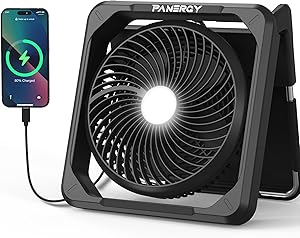
- Power: 10,000mAh Battery & 10W Solar Panel
- Runtime: 5 to 67 Hours per charge
- Speed: High-speed brushless motor (1500 RPM)
- Lighting: 3-Level LED with 67-hour duration
The PANERGY Portable Fan is a powerhouse for RVers who enjoy dry camping or boondocking. It features a massive 10,000mAh battery that can double as a power bank for your mobile devices. The standout feature is the detachable 10W solar panel, which allows you to harness green energy throughout the day, ensuring you never run out of cooling airflow during summer heatwaves.
Designed for versatility, this fan offers a pivoting head and an adjustable stand to direct air precisely where needed. The quiet brushless motor provides a strong 13ft/s breeze without the annoying hum of traditional fans. With built-in timers and a soft LED light, it is the perfect companion for bedside use in a cramped RV bedroom or for evening gatherings outside under the stars.
- Pros:
- Detachable solar panel for off-grid use
- Huge battery capacity with power bank function
- Ultra-quiet motor with strong airflow
- Cons:
- Solar charging is slower than USB
- Slightly bulky for tiny windows
2. SKYRI Portable USB Mini RV Ceiling Fan

- Size: 16.5-Inch diameter blade span
- Interface: USB-A cord powered (5V-2A)
- Weight: Compact and lightweight design
- Blades: 3-Blade efficient airflow system
The SKYRI Portable Ceiling Fan is an ingenious solution for RVers looking to improve overhead circulation without complex wiring. This 16.5-inch fan is specifically designed to be hung from rafters, canopy frames, or tent poles. Because it is powered via a standard USB cord, it can run directly off your RV’s USB ports or a wall adapter, making it highly energy-efficient.
While small in stature, this mini ceiling fan provides a consistent, soft breeze that is surprisingly effective at cooling small areas. It operates with very little noise, ensuring your sleep isn’t disturbed. It is easy to dismantle and store, making it a great temporary addition to your living space. Note that it requires a steady 5V power source and does not include an internal battery.
- Pros:
- Easy to hang and dismantle
- Low energy consumption via USB
- Soft wind is ideal for sleeping
- Cons:
- No internal battery (corded only)
- No remote control functionality
3. Geek Aire Oscillating Rechargeable Desk Fan

- Runtime: 4.5 to 12 Hours cordless use
- Oscillation: 120-Degree wide-angle sweep
- Noise: Ultra-quiet operation (under 30dB)
- Design: Foldable with wall-mount holes
The Geek Aire Personal Cooling Fan is an essential for RV owners who prioritize quiet operation and storage efficiency. This fan folds down to just one-third of its size, allowing it to fit into shallow cabinets or suitcases easily. Despite its compact footprint, it offers a 120-degree oscillation feature that ensures your entire RV dinette or bedroom area receives a steady stream of fresh air.
Equipped with dimmable LED lights, it doubles as a convenient nightlight for late-night reading. The twist-off front cover makes cleaning dust and pet hair a breeze, which is vital in the dusty environments often encountered at campgrounds. Whether placed on a table or mounted to a wall, this rechargeable unit provides consistent, high-torque cooling without the need for constant hunting for power outlets.
- Pros:
- Folds flat for exceptional storage
- Quiet enough for sensitive sleepers
- Wide 120° oscillation coverage
- Cons:
- Battery life is limited on high speed
- Charges slower than some PD models
4. Odoland 30,000mAh Oscillating Camping Fan

- Capacity: Massive 30,000mAh Internal Battery
- Movement: 90°/45° Auto-oscillation & 270° swivel
- Control: 25ft Wireless Remote Control included
- Duration: Up to 136 hours on low setting
For those who need maximum longevity, the Odoland 30,000mAh fan is the ultimate heavy-duty choice. This beast can run for nearly 136 hours on its lowest setting, meaning you could theoretically use it for an entire week-long trip on a single charge. It also supports reverse charging, allowing you to use the fan as a high-capacity power bank for your GPS or smartphone during emergencies.
The fan is rich with features, including automatic oscillation and a 270-degree swivel head to maximize comfort. A remote control allows you to adjust speeds or timers from the comfort of your RV bed. Whether you hang it from the built-in hook or stand it on a counter, this fan’s four speed settings and super-bright LED lantern make it a versatile tool for any camper.
- Pros:
- Market-leading 30,000mAh battery life
- Convenient remote control operation
- Auto-oscillation for better air mixing
- Cons:
- Heavier than standard portable fans
- Long 7-8 hour recharge time
5. LIPETY Foldable Oscillating Standing Fan

- Battery: 7200mAh USB-C Rechargeable
- Modes: 4 Wind levels (Breeze to Natural)
- Acoustics: Super silent 30~40dB range
LIPETY offers a unique 9-inch fan that bridges the gap between a desk fan and a full-height pedestal fan. Its telescopic design allows it to extend from a 4-inch pancake to a 40-inch standing unit. This adaptability makes it perfect for an RV, as it can sit on a bedside table during the night or stand on the floor to circulate air while you are cooking at the galley.
The fan includes a 70-degree oscillation feature and a remote control for effortless management of its four wind modes. It is exceptionally quiet, making it suitable for sleep environments. Maintenance is simple thanks to the detachable front grille, and the anti-slip silicone base ensures it stays stable on the moving surfaces of a travel trailer or motorhome during stops.
- Pros:
- Converts from desk to floor fan easily
- Extremely quiet sleep mode
- Compact when fully folded for travel
- Cons:
- Height pole can be slightly wobbly
- Lower battery capacity than bulkier models
6. VENTY Original Wireless Oscillating Fan

- Battery: High-density 16,000mAh capacity
- Port: Upgraded single USB-C (Input/Output)
- Weight: Robust yet light 2.6 lbs
- Range: 120° Oscillation & 180° Rotation
The VENTY Original is often cited as the gold standard for premium wireless fans. It is a sleek, foldable unit that manages to squeeze a 16,000mAh battery into a very portable frame. This battery provides up to 48 hours of run time and can charge your phone via the bidirectional USB-C port. Its aesthetic design makes it look right at home in high-end RV interiors or modern campers.
What sets the VENTY apart is its build quality and smooth rotation mechanics. It oscillates 120 degrees and allows for 180-degree head tilt, providing total control over your cooling zone. It includes a detachable remote and warm LED ambient lighting. The addition of a dedicated carrying case in this bundle ensures the fan stays protected from scratches during your rugged travel transitions.
- Pros:
- Premium build quality and aesthetics
- Includes a high-quality carrying case
- Long 48-hour battery life
- Cons:
- Higher price point than competitors
- Single port requires cable swapping
7. Koonie 10,000mAh Sturdy Clip-on Fan

- Mount: Heavy-duty 3-inch industrial clamp
- Battery: 10,000mAh rechargeable (24hr use)
- Charging: 5V-2A Fast charging (6 hours full)
- Flexibility: 360-degree vertical/horizontal rotation
The Koonie Clip-on Fan is the ultimate space-saver for RVs where counter space is at a premium. Its massive 3-inch clamp can attach to bunk bed frames, cabinet edges, or treadmill handles, turning any corner into a cooling zone. The 10,000mAh battery provides a reliable 24 hours of operation on a single charge, making it ideal for overnight use without needing a cord.
This 8-inch fan uses specialized blade technology to deliver strong airflow while remaining exceptionally quiet, even on its highest speed. The head offers 360-degree rotation in both directions, allowing for infinite adjustment. With fast-charging support via Type-C and a sturdy build, it is a practical, no-nonsense tool that solves the airflow problem in tight RV cabins and bathrooms effortlessly.
- Pros:
- Versatile clip-on or desk-standing design
- Strong, directed airflow
- Fast recharging for a large battery
- Cons:
- No remote control included
- No built-in LED lighting
How to Choose the Best Portable Fans For Rv
Understanding RV Airflow Dynamics
Living in an RV presents unique cooling challenges. Because motorhomes and travel trailers are smaller than traditional homes and often have limited insulation, they heat up rapidly in direct sunlight. Portable fans are essential for “air mixing”—the process of moving the cool air from your AC unit or open windows throughout the cabin. When choosing a fan, consider where the “dead spots” are in your layout. Typically, the bedroom area or the kitchen galley requires more targeted airflow. Choosing a fan with oscillation or a swivel head helps ensure that air doesn’t just blow in one direction but circulates around corners and furniture.
Battery Capacity and Off-Grid Capability
For many RVers, “boondocking” (camping without hookups) is the primary way to travel. In these scenarios, you cannot rely on 110V AC power. This is where battery-powered fans shine. Look for units with at least 10,000mAh of capacity. If you plan to be off-grid for several days, consider a “powerhouse” fan with 30,000mAh or a model that includes solar panels. A fan that can run for 40+ hours on a single charge ensures you stay cool through the night without draining your RV’s house batteries. Additionally, fans with USB-C “output” can serve as emergency chargers for your phones and tablets.
Size, Weight, and Storage Efficiency
Space is the most precious commodity in any RV. A fan that takes up too much counter space or is difficult to store when not in use will eventually become a nuisance. Look for “foldable” or “telescopic” designs. Some modern fans can fold down to a flat disc just 4 inches thick, making them easy to slide into a drawer or under a bed. For those with extremely limited space, clip-on fans or hanging ceiling fans are superior choices as they utilize vertical space or “clamping” onto furniture, keeping your surfaces clear for cooking and dining.
Telescopic vs. Fixed Height
Telescopic fans offer incredible versatility. They can function as a short desk fan while you’re working at the dinette or extend to a full 40-inch pedestal fan to blow air across the floor. This “two-in-one” functionality is highly valued in the RV community because it eliminates the need to carry multiple fans for different purposes. However, ensure the extension pole is made of durable materials like aluminum to avoid wobbling when the fan is at its highest setting.
Power Sources: USB vs. AC vs. DC
How you power your fan depends on your RV’s electrical setup. Most portable fans today use USB-C charging, which is ideal because almost all modern RVs have USB ports built into the walls. USB fans are also highly efficient and can be powered by portable power banks. Some older RV fans might use a 12V cigarette lighter plug (DC), which is great for the dashboard while driving but less convenient for the living area. Avoid fans that only work on 110V AC unless you always stay at campgrounds with shore power, as they will require an inverter to work while you’re on the road, which is highly inefficient.
Noise Levels and Sleep Quality
RV bedrooms are small, and a loud fan can easily disrupt your sleep. Look for fans that use brushless motors, as these are inherently quieter and more durable than brushed alternatives. A noise level below 30dB is considered “whisper quiet” and is ideal for nighttime use. Some fans even feature a “Sleep Mode” or “Natural Wind” setting that varies the speed slightly to mimic a breeze, which many campers find more soothing than a constant, droning blast of air. Check reviews specifically for mentions of “clicking” or “whirring” sounds in the oscillation mechanism.
Durability and Ease of Cleaning
RV life can be dusty. Between open windows and pet hair, fan blades can quickly become coated in grime, which reduces efficiency and blows allergens around your living space. Choose a fan with a “removable grille.” This allows you to easily wipe down the blades without needing a screwdriver. Furthermore, because your gear will be bouncing around while you drive, look for fans with silicone anti-slip bases and robust hinges. A fan built with high-impact ABS plastic is less likely to crack during a bumpy mountain pass than cheaper, more brittle materials.
Oscillation and Directional Control
Static fans only cool the person directly in front of them. In a shared RV space, oscillation is a must-have feature. A fan that can sweep 90 to 120 degrees ensures that everyone on the sofa or in the bunk beds stays comfortable. Vertical rotation is equally important; for example, you might want to point a fan toward the ceiling to break up the layer of hot air that accumulates near the roof. Fans with 360-degree rotation provide the most flexibility for these scenarios.
Integrated Features: Lights, Timers, and Remotes
In an RV, multi-functional tools are always preferred. Many fans now include built-in LED lanterns with multiple brightness settings, which can replace a dedicated camping light. Timers are also a great way to conserve battery; you can set the fan to run for 2 or 4 hours as you fall asleep, and it will shut off automatically. Finally, a remote control is a luxury that becomes a necessity when your fan is clipped to a high cabinet or hanging from the ceiling. Being able to adjust the speed without getting out of your sleeping bag is a game-changer.
Charging Speed and Standards
If your fan has a large battery (like 20,000mAh or more), charging speed becomes critical. A fan that only supports slow charging might take 15 hours to refill. Look for “Fast Charging” or “5V/2A” input specifications, which can cut that time down to 5 or 6 hours. USB-C is currently the most universal and reliable charging standard. Some premium fans even include “PD” (Power Delivery) support, which is the fastest way to top up a large battery before your next leg of the journey.
Warranty and Brand Reputation
Portable fans are subject to a lot of wear and tear. When shopping, check for a warranty—typically 12 to 24 months. Brands that specialize in camping gear (like PANERGY, Odoland, or VENTY) often have better customer support and understand the specific needs of the RV community. Reading the “What’s in the box” section is also important; some fans include carrying cases, extra cables, or hanging hooks, which add significant value to your purchase. Investing a bit more in a reputable brand usually pays off in terms of motor longevity and battery health over several camping seasons.