Best Composting Toilets For RV of 2026
Embracing RV life offers unparalleled freedom, but managing waste can be a challenge. Composting toilets provide an eco-friendly, odor-free solution, freeing you from constant dump station searches and harsh chemicals. These innovative systems are perfect for enhancing your mobile comfort, offering a sustainable and convenient bathroom experience wherever your adventures take you. Dive into our top picks to find the ideal composting toilet for your RV!
1. BOXIO Toilet – Portable Mini Composting Toilet
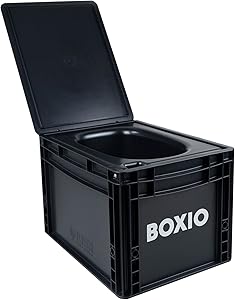
- Urine Canister Capacity: 5 liters (8-10 uses)
- Weight: 6.2 lbs
- Load Capacity: 330 lbs
The BOXIO Toilet offers a highly compact and efficient solution for your mobile adventures, whether you’re in a van, camper, or even just car camping. Designed and made in Germany, this mini composting toilet stands out for its robust construction and minimalist design, making it a true alternative to traditional home toilets without the need for complex plumbing or chemicals. Its small footprint ensures it fits seamlessly into tight spaces, enhancing convenience for all your outdoor escapades.
This portable potty ensures a hygienic and virtually odor-free experience, thanks to its optimized 5-liter urine canister and the recommended use of PLUG and HEMP litter. It eliminates dependence on disposal stations, giving you greater independence. Easy to clean and incredibly stable, the BOXIO is a reliable companion for van life, camping, hunting, or fishing, especially when paired with its available accessories like biodegradable waste bags.
- Pros:
- Extremely compact and portable
- Hygienic and odor-free design
- No chemicals or water required
- Cons:
- Smaller capacity requires more frequent emptying
- Urine canister size might be limiting for longer trips
2. YITAMOTOR Portable Camping Toilet – RV Travel Toilet

- Dimensions: 15″D x 18″W x 17″H
- Fresh Water Tank: 3.17 gallons
- Waste Water Tank: 5.28 gallons
- Load Capacity: 275 lbs
The YITAMOTOR Portable Camping Toilet offers a robust and practical bathroom solution for RVers and campers seeking comfort in remote locations. Its compact dimensions make it a suitable addition to various RV setups, providing a clean and functional alternative to public restrooms. The toilet’s design focuses on extended use, with generous fresh and wastewater tanks that allow for longer trips without immediate concern for facilities.
Featuring an efficient double-flush system powered by an integrated pump, this toilet ensures powerful cleaning without needing batteries or external plumbing. The instant-sealing slide valve is key for preventing leaks and containing odors, making your experience more pleasant. With a substantial 275 lbs load capacity, it promises durability and confidence during all your outdoor adventures, combining convenience with sturdy construction for peace of mind.
- Pros:
- Generous tank capacities for extended use
- Efficient double-flush system
- Effective odor-blocking slide valve
- Cons:
- Requires water for flushing
- Not a true composting toilet (more of a portable chemical toilet)
3. TRELINO Composting Toilet Evo S Gray

- Dimensions: 13″ x 15.4″ x 11.7″
- Urine Container Capacity: 1.2 gallons
- Solid Waste Container Capacity: 1.6 gallons
- Load Capacity: 330 lbs
The TRELINO Composting Toilet Evo S Gray offers a sophisticated and practical solution for maintaining comfort on the go, even in small spaces like vans or tents. Designed and manufactured in Germany, this toilet emphasizes quality and responsibility using recyclable ABS plastic. Its clean, modern design hides a robust and stable construction, capable of supporting up to 330 lbs, ensuring reliability and durability for all your outdoor adventures.
A standout feature is its highly effective separation and drying function, which actively prevents odor formation without the need for chemicals or water. This independence from dump stations simplifies waste management significantly. With separately emptyable containers for urine (1.2 gallons) and solid waste (1.6 gallons), it accommodates a fair number of uses before cleaning, making it a hygienic and low-maintenance choice for environmentally conscious travelers.
- Pros:
- Compact size, ideal for small spaces
- Highly effective odor prevention
- Chemical and water-free operation
- Cons:
- Smaller capacity requires more frequent emptying
- Solid waste capacity might be tight for longer trips
4. TROBOLO WandaGO Composting Toilet

- Dimensions: 12.3” (H) x 15.0” (D) x 13.4” (W)
- Weight: 10.4 lbs
- Load Capacity: 330.7 lbs
- Uses: 10-20 urine, 8-12 defecation
The TROBOLO WandaGO Composting Toilet is an excellent choice for mobile adventurers seeking a compact, lightweight, and highly functional waste management solution. Its small dimensions and minimal weight make it incredibly easy to store in campervan compartments or other tight spaces. A standout feature is the adjustable seat height (12.0” or 17.2”), catering to various user preferences and ensuring ergonomic comfort, a thoughtful addition for extended use.
This toilet excels in odor control through its clean separation of urine and solids, eliminating the need for chemicals, water, or electricity. The innovative TROBOLO SafeShell System provides extra protection against smells and spills, enhancing hygiene and peace of mind. Designed for travel, it features a firmly closing lid and a practical fastening system, ensuring security on the move. Its generous capacity for uses before emptying and a built-in urine level indicator add to its convenience and efficiency.
- Pros:
- Compact, lightweight, and portable
- Adjustable and ergonomic seat height
- Odorless and spill-proof design
- Cons:
- Capacity may require semi-frequent emptying
- Requires dry medium for solid waste
5. NOMAD by OGO Portable Compost Toilet
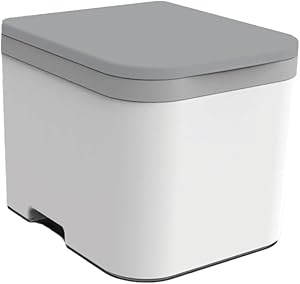
- Power Requirement: No electric, no plumbing
- Waste System: Urine diverting, fits 8-gallon bags
- Odour Control: Separation design
- Manufacturing: Made in the USA
The NOMAD by OGO Portable Compost Toilet is meticulously designed for the true adventurer, prioritizing simplicity and rugged functionality. Requiring no electricity or plumbing, it’s the ideal, hassle-free solution for environments where power is scarce, such as truck campers, primitive campsites, or small boats. Its compact footprint ensures it fits easily into various vehicles and temporary shelters, making it highly versatile for any outdoor excursion.
This toilet boasts an effective urine-diverting system that separates liquids from solids, preventing odors without chemicals, black tanks, or septic connections. This means longer stays outdoors and no reliance on dump stations. The simple bag system works with readily available 8-gallon bags, making cleanup incredibly easy and efficient for quick campsite turnovers. Built with durable materials in the USA, the NOMAD is made to withstand the elements and repeated use, offering low maintenance and reliable performance.
- Pros:
- No electricity or plumbing required
- Effective odor-free urine diverting system
- Compact and space-saving design
- Cons:
- Requires active management of solid waste bags
- No integrated fan for ventilation
6. OGO™ Compost Toilet – Electric Mixing

- Power: Electric mixing
- Solid Waste Capacity: 25-30 uses
- Urine Bottle Capacity: 2.4 gallons
- Load Capacity: Up to 550 lbs
The OGO™ Compost Toilet stands out as a premium choice for RVs, tiny homes, vans, and boats, offering an advanced and virtually odorless waste management system. Manufactured and assembled in Ohio, USA, it combines quality construction with a sleek, modern design that can hold up to 550 lbs, ensuring both durability and a refined aesthetic. Its electric mixing function and urine-separating design are key to preventing odors, eliminating the need for chemicals and freeing you from reliance on dump stations.
Engineered for convenience, the OGO™ provides an elevated comfort level, regardless of your mobile lifestyle. It features a removable solids bin and urine bottle, making emptying and cleaning a straightforward and hygienic process. With a substantial capacity for 25-30 solid waste uses and a 2.4-gallon urine bottle, it’s designed for extended periods between maintenance. The inclusion of a urine level sensor further enhances user convenience, ensuring you’re always aware of the filling status.
- Pros:
- Excellent odor control with separation and electric mixing
- High-quality, durable construction (USA-made)
- Large waste capacity for extended use
- Cons:
- Requires electrical power for mixing function
- Higher initial cost compared to non-electric models
How to Choose Composting Toilets For RV
Embarking on an RV adventure promises unparalleled freedom, yet the practicalities of waste management can sometimes dampen the spirit. Traditional RV black tanks require frequent visits to dump stations, consume precious water, and often come with unpleasant odors. This is where composting toilets shine as a game-changer for the modern RVer. Offering an eco-friendly, water-saving, and largely odor-free solution, composting toilets allow you to spend more time off-grid and less time worrying about disposal. But with various models and features available, choosing the “best” one for your RV requires careful consideration. This guide will walk you through the essential factors to help you make an informed decision, ensuring your mobile bathroom experience is as comfortable and convenient as possible.
Why Composting Toilets Are Ideal for RVs
Composting toilets offer several distinct advantages over conventional RV toilets. Firstly, they eliminate the need for a black tank, a notorious source of odors and a significant consumer of fresh water. By separating liquid and solid waste, they greatly reduce smell and create a more manageable waste stream. Solid waste, mixed with a carbon-rich medium like sawdust or coco coir, begins a drying and decomposition process, which is far more environmentally friendly than chemical treatment. Urine, collected separately, can often be safely diluted and dispersed in appropriate locations, or poured into a regular toilet. This independence from dump stations means longer boondocking trips, reduced environmental impact, and a more pleasant odor-free interior for your RV.
Key Factors to Consider When Choosing Your RV Composting Toilet
Selecting the right composting toilet involves evaluating several critical aspects that will impact its functionality, convenience, and suitability for your specific RV setup and travel style.
Type of Composting Toilet: Urine-Diverting vs. Dry
Most RV composting toilets are urine-diverting. This means they physically separate liquid and solid waste at the point of use. This separation is crucial for odor control, as the mixing of urine and feces is what primarily creates unpleasant smells. Dry toilets, while also waterless, might not always include a diversion system, meaning solids and liquids mix, potentially leading to more odors unless a significant amount of cover material is consistently used. For RVs, urine-diverting models are almost always preferred due to their superior odor management and simplified waste handling.
Capacity: Urine and Solids
The capacity of both the urine bottle and the solid waste container is a major consideration, directly influencing how often you’ll need to empty the toilet. Urine bottles typically range from 1 to 2.5 gallons, lasting a few days for one or two people. Solid waste containers vary more widely, often lasting anywhere from a week to a month, depending on usage and how well the drying process works. For extended off-grid stays, higher capacity units are desirable, though they might also be larger in physical size. Consider your typical trip length and the number of users to determine your ideal capacity.
Size and Dimensions
RV bathrooms are often compact, so the physical dimensions of the composting toilet are paramount. Measure your available space carefully, considering height, width, and depth. Some units are designed to be extremely compact, while others are closer to standard home toilet sizes. Also, think about clearance for opening lids and accessing containers for emptying. A smaller footprint might be ideal for van conversions, while larger RVs might accommodate a more substantial unit.
Ventilation Requirements
Proper ventilation is crucial for minimizing odors and facilitating the drying process of solid waste. Many composting toilets have a small, low-power 12V fan that vents odors outside, often through an existing roof vent or a dedicated small hole. Ensure your RV can accommodate the venting system required by your chosen toilet. Some simpler models rely solely on the cover material and the urine-diverting mechanism, but a fan-assisted system generally offers superior odor control, especially in warmer climates or smaller spaces.
Material and Durability
Composting toilets for RVs are subjected to various conditions, from road vibrations to temperature fluctuations. Look for units made from durable, high-quality materials such as robust plastics (e.g., ABS, HDPE) or fiberglass, which are easy to clean and resistant to wear and tear. Construction quality impacts longevity, so investing in a well-built unit can save you money and headaches in the long run.
Ease of Emptying and Cleaning
No one wants a complicated waste disposal process. Choose a toilet with easily accessible and removable urine bottles and solid waste containers. Look for designs that allow for quick and clean emptying, with wide openings for the urine bottle and secure lids for the solid waste bin. The surfaces should be smooth and non-porous for effortless cleaning. Some models also offer liners for the solid waste container, simplifying disposal even further.
Odor Control
While urine diversion is the primary odor control mechanism, other features contribute. A well-sealed design, a good cover material (like coco coir or peat moss), and an effective ventilation system (especially an integrated fan) all play a role. Read reviews to see real-world experiences with odor management. An effective composting toilet should be virtually odor-free inside your RV.
Power Requirements (if any)
Most composting toilets are designed to be low-power. Electric models typically only require a small 12V power source for their ventilation fan or an agitator (for self-mixing models). Non-electric models are entirely manual. Consider your RV’s power system and your off-grid capabilities. If you frequently boondock without shore power, a low-power or non-electric model might be preferable.
Installation
Evaluate the installation requirements of your chosen toilet. Some are freestanding and simply need to be placed in your bathroom, while others might require securing to the floor or installing a vent hose. Assess whether you’re comfortable with a DIY installation or if professional help might be needed.
Cost
Composting toilets for RVs can range significantly in price, from a few hundred dollars for basic portable models to over a thousand for advanced, built-in units. Set a budget and balance it against the features and durability you require. Remember to factor in the cost of consumables like composting medium and any potential installation accessories.
Benefits of Composting Toilets for RV Travel
Beyond the primary advantage of waste independence, composting toilets bring a host of benefits that enhance the RV experience. They are inherently more environmentally friendly, reducing reliance on fresh water and eliminating the need for harsh chemicals commonly used in black tanks. The waste they produce is often manageable and biodegradable, making disposal less impactful. Psychologically, the absence of black tank odors can significantly improve the comfort and enjoyment of your living space. Moreover, the freedom from seeking dump stations saves time and allows for greater flexibility in choosing your camping spots, truly opening up the possibilities of extended off-grid travel.
Maintenance Tips for Your RV Composting Toilet
To ensure your composting toilet remains odor-free and functions optimally, regular maintenance is key. Always use a proper cover material for solid waste, ensuring it completely covers deposits. Empty the urine bottle regularly to prevent odors, and clean it with a diluted vinegar solution or non-toxic cleaner. For the solids container, ensure adequate moisture balance – it should be damp but not wet. If your unit has a fan, keep the vent clear of obstructions. Periodically, you might need to clean the entire unit, wiping down surfaces with mild, eco-friendly cleaners. Following the manufacturer’s specific guidelines will ensure the longevity and effectiveness of your composting toilet, making it a reliable part of your RV adventures for years to come.
Conclusion
Choosing the best composting toilet for your RV is an investment in freedom, convenience, and environmental responsibility. By carefully considering factors like capacity, size, ventilation, and ease of maintenance, you can find a unit that perfectly complements your RV lifestyle. Say goodbye to black tank woes and hello to a cleaner, greener, and more liberating RV experience. With the right composting toilet, your adventures can truly take you anywhere, for as long as you desire, without compromising on comfort or sustainability.