Best RV Cellular Signal Boosters of 2026
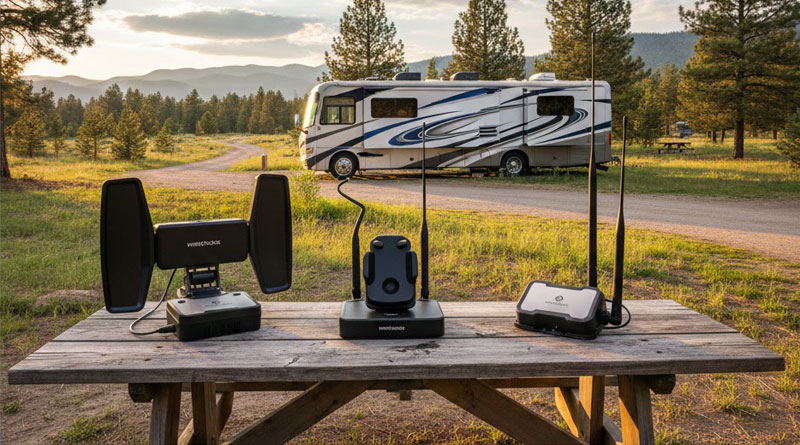
RV cellular signal boosters offer a robust solution, transforming frustrating dead zones into reliable connectivity hubs. These ingenious devices amplify existing weak signals, ensuring fewer dropped calls, faster data speeds, and consistent access to your digital life, whether you’re parked at a remote campsite or cruising down a scenic highway. This guide will help you navigate the options to find the perfect booster for your mobile lifestyle.
1. HiBoost Travel 2.0 RV Cell Phone Signal Booster
- Max Gain: 50dB
- Compatibility: All U.S. Carriers
- Approval: FCC Approved (OWWC110505S)
- Monitoring: Signal Supervisor App
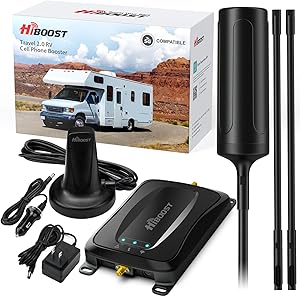
The HiBoost Travel 2.0 RV Booster Kit is designed to significantly enhance cellular signal for RVers, whether stationary or on the move. It powerfully boosts 4G and 5G LTE signals, addressing common issues like dropped calls, poor voice quality, and slow data speeds. This booster effectively improves hotspot capability and optimizes audio/video streaming. The system is engineered to work across all major U.S. carriers, including Verizon, AT&T, and T-Mobile. Its FCC approval and 5G compatibility underscore its modern design and regulatory compliance.
One of the standout features of the HiBoost Travel 2.0 is its flexible indoor antenna, which comes with a generous 13-foot cable. This allows users to easily reposition the antenna to optimize signal strength precisely where it’s needed most—whether you’re working on a laptop at a desk, streaming a movie in bed, or using your phone as a hotspot. This adaptability ensures that you can always direct the boosted signal to your active devices. Additionally, the included Signal Supervisor app offers a convenient way to monitor signal strength changes.
- Pros:
- Strong signal boost for calls, data, and streaming.
- Flexible indoor antenna for targeted signal.
- Wide compatibility with all major U.S. carriers and 5G.
- Cons:
- Requires manual repositioning of indoor antenna for optimal localized signal.
- Relies on an app for full performance monitoring.
2. weBoost Drive X RV Cell Phone Signal Booster Kit

- Carrier Compatibility: All U.S. & Canadian Carriers
- Range Improvement: Up to 33% farther than Drive Sleek
- FCC Approval: PWO460021
- Installation: DIY, no drilling required
The weBoost Drive X RV signal booster kit is engineered to provide reliable cellular connectivity across both U.S. and Canadian networks, significantly enhancing your mobile experience in your RV. This booster boasts an impressive capability to reach cell towers up to 33% farther than the Weboost Drive Sleek, translating into fewer dropped calls, superior voice quality, and noticeably faster mobile internet speeds. It also improves audio and video streaming, alongside boosting hotspot capability. The multi-user functionality ensures that every passenger can benefit from a stronger signal.
A key advantage of the Drive X RV is its user-friendly design, particularly evident in the DIY installation process which requires no drilling into your RV, simplifying setup and preserving your vehicle’s integrity. The rugged outside antenna features a modular design. This adaptability allows you to optimize its performance for different environments and conditions, whether you’re parked or on the move. As a product made in the U.S. and FCC approved, the weBoost Drive X RV offers peace of mind through its robust construction and adherence to regulatory standards.
- Pros:
- Extended range for reaching distant cell towers.
- Multi-user support for all passengers and devices.
- Modular outdoor antenna design for flexible mounting.
- Cons:
- Does not specify maximum gain in dB.
- No app for active signal monitoring or fine-tuning.
3. SureCall Fusion2Go 3.0 RV Cell Signal Booster

- Technology: SureCall 2XP Technology (up to 2x output power)
- Compatibility: All North American Carriers, 5G Phone Compatible
- External Antenna: Permanent Omni-directional
- Internal Antenna: Whip-style
The SureCall Fusion2Go 3.0 RV is a robust cell phone signal amplifier designed to combat weak signals for multiple devices within your motorhome or camper. Utilizing SureCall’s exclusive 2XP Technology, this booster delivers up to twice the output power compared to similar boosters. This translates directly into fewer dropped calls, improved battery life for your devices, higher audio quality during conversations, and faster data and streaming capabilities, which are essential for cross-country travel or staying connected in remote areas. Its comprehensive compatibility with all North American carriers.
This booster kit comes equipped with a permanent omni-directional external antenna and a convenient whip-style indoor antenna. The omni-directional outdoor antenna simplifies setup as it doesn’t require precise aiming at cell towers. The whip-style indoor antenna broadcasts the boosted signal throughout your RV, with the strongest signal typically found closest to the antenna. The Fusion2Go 3.0 RV is also future-proof, being fully 5G phone compatible. Assembled and tested in the USA with high-quality materials and durable metal housing, this unit is built to last and provides reliable connectivity for your RV adventures.
- Pros:
- Enhances signal for multiple devices simultaneously.
- 2XP Technology extends range from cell towers.
- Compatible with all major North American carriers, including 5G.
- Cons:
- Signal is strongest near the indoor whip antenna, not uniform throughout RV.
- Permanent omni-directional antenna might offer less targeted gain than a directional antenna.
4. TFCFL 2G/3G/4G GSM Mobile Signal Amplifier Kit
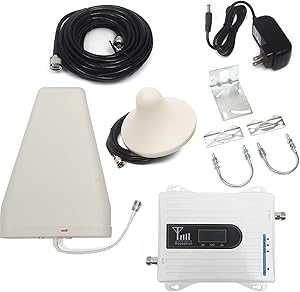
- Frequency Bands: GSM DCS WCDMA 900/1800/2100MHz (2G/3G/4G)
- Coverage Area: Up to 300-500㎡ (without barriers)
- Housing Material: Aluminum Alloy
- Simultaneous Users: Supports 20+ cell phones
The TFCFL Cell Phone Signal Booster is primarily designed to eliminate indoor cellular signal blind spots. This particular model operates on GSM DCS WCDMA 900/1800/2100MHz bands, offering a signal boost for 2G, 3G, and some 4G networks. It boasts a wide coverage area of 300-500 square meters without barriers and can support more than 20 cell phones simultaneously, which is impressive for multi-user environments. The device is built with a durable and aesthetically pleasing aluminum alloy shell, designed for excellent heat dissipation, ensuring longevity and reliable performance. Its wall-mounting design makes installation light and flexible, adapting to various indoor settings.
However, a critical consideration for RV users in North America is the limited frequency band compatibility. This booster is specifically tailored for GSM 900/1800 and WCDMA 2100MHz, which are common in many parts of the world but do not fully cover the primary LTE and 5G bands used by major U.S. and Canadian carriers. This means it may not significantly improve modern data speeds or connect to all available networks in North America. Furthermore, there’s no mention of FCC approval, which is a mandatory requirement for cell signal boosters operating legally in the United States.
- Pros:
- Expansive coverage area of 300-500㎡.
- Durable aluminum alloy shell with good heat dissipation.
- Supports a large number of simultaneous users (20+).
- Cons:
- Limited frequency band compatibility, not ideal for modern North American LTE/5G.
- Does not boost 5G networks.
5. weBoost Destination RV Cell Phone Signal Booster

- Usage: Stationary RVs, trailers, campers
- Antenna Type: Directional, with 10-minute setup
- Compatibility: All U.S. & Canadian Carriers, 5G compatible
- Approval: FCC Approved
The weBoost Destination RV is specifically designed to maximize cellular connectivity for RVers who are parked at a campsite, remote destination, or even a backyard. Unlike boosters designed for on-the-go use, this system is optimized for stationary performance. This targeted approach ensures superior signal amplification for streaming entertainment, using GPS, or maintaining a reliable hotspot from your RV, trailer, or camper. It supports the latest 5G technology alongside 4G LTE. With multi-user functionality, everyone in your RV can benefit from the boosted signal across all major U.S. and Canadian carriers, including Verizon, T-Mobile, AT&T, and others.
One of the significant advantages of the weBoost Destination RV is its quick and easy 10-minute setup and takedown process. This means you can swiftly deploy the system when you arrive at your destination and pack it away just as easily when you’re ready to move. The directional antenna, while requiring aiming, ensures you capture the best possible signal from the nearest tower, a crucial feature in fringe areas. As a product crafted in the USA and FCC approved, it embodies a commitment to quality and regulatory compliance. The weBoost app provides straightforward installation instructions, making the DIY process accessible, and their expert customer support via various channels ensures assistance is always at hand.
- Pros:
- Optimized for powerful stationary signal boosting.
- Quick 10-minute setup and takedown.
- Supports 5G and multiple users across all US/Canadian carriers.
- Cons:
- Not designed for use while the RV is in motion.
- Directional antenna requires manual aiming for optimal performance.
6. HiBoost Travel 3.0 RV Max Cell Phone Booster

- Max Gain: 50dB
- Antenna Mount: 180° Adjustable Folding Bracket
- Cable Length: Upgraded 26ft high-purity copper cable
- Compatibility: All U.S. Carriers (Band 12/17, 13, 5, 4, 25/2), 5G LTE
The HiBoost Travel 3.0 RV Max, marketed as a 2025 new version, is engineered to provide a high-gain signal boost for various RVs, including Class A, B, and C campers, vans, trailers, and even houseboats. With a maximum gain of 50dB, it’s designed to enhance weak cellular signals for both 4G and 5G LTE networks across all major U.S. carriers like Verizon, AT&T, and T-Mobile. This multi-user booster is ideal for keeping everyone connected, facilitating remote work, seamless streaming, reliable GPS, and clear calls, even when traveling through challenging signal environments. Its comprehensive carrier compatibility across certified FCC bands ensures broad usability wherever your journey takes you.
A key innovation of the Travel 3.0 RV Max is its 180° adjustable folding bracket, crafted from sturdy metal. This versatile mounting solution allows the antenna to be positioned at various angles (45°, 90°, 135°, 180°) for optimal signal reception and can be folded and locked for compact storage while not in use. The ultra-durable outdoor antenna is built to withstand harsh conditions. New components like a roof cable entry cover, an upgraded 26ft high-purity copper cable (reducing signal loss by 30%), and flexible 12V DC/120V AC power options further enhance its functionality and ease of integration into any RV setup.
- Pros:
- High-gain design suitable for various RV types.
- Robust, weatherproof, and impact-resistant outdoor antenna.
- Flexible 180° adjustable and foldable mounting bracket.
- Cons:
- Max gain of 50dB might be insufficient for extremely weak signal areas.
- Requires a more involved installation compared to magnetic-mount options.
7. weBoost Drive Reach RV II Cell Phone Signal Booster Kit

- Signal Reach: Up to 3X distance from nearest tower
- Outside Antenna Mount: 180° versatile bracket (T-slot, pole, fixed)
- Inside Antenna: Powerful mini panel, directional
- Power Options: AC/DC wall power and hardwire connections
The weBoost Drive Reach RV II cell phone signal booster kit represents a significant upgrade for RV enthusiasts seeking robust cellular connectivity on the go. This model is engineered to enhance signal reach up to three times the distance from the nearest cell tower, drastically reducing dropped calls by as much as 90%. It boosts both 4G LTE and 5G signals for all major U.S. carriers, including Verizon, AT&T, and T-Mobile, ensuring consistent communication and data access throughout your travels. The kit features a durable outdoor antenna paired with a versatile 180° mounting bracket, allowing for T-slot, pole, or fixed installation.
Further enhancing its design, the Drive Reach RV II includes a new cable entry cover that supports optimal antenna placement and direct, clean cable routing into your RV. An updated 25-foot flexible cable reduces attenuation, delivering a stronger signal to the booster while simplifying installation. Inside, a new powerful mini panel antenna provides higher signal gain, directing the boosted signal precisely where it’s most needed within the RV, thanks to its repositionable nature.
- Pros:
- Significantly extends signal reach (up to 3X distance).
- Versatile 180° mounting bracket for outdoor antenna.
- New cable entry cover and improved cable for easier routing.
- Cons:
- Directional indoor antenna requires optimal placement for concentrated signal.
- “Up to 3X distance” is a relative metric, not an absolute gain value.
How to Choose RV Cellular Signal Boosters
Embarking on an RV journey promises freedom and adventure, but it often comes with the challenge of staying connected in remote areas. Whether you rely on your phone for navigation, entertainment, remote work, or emergencies, a strong cellular signal is paramount. This is where an RV cellular signal booster becomes an indispensable tool. A signal booster acts as an amplifier, capturing weak outdoor signals, enhancing them, and rebroadcasting a stronger signal inside your RV. Choosing the right one, however, involves understanding various technical specifications and matching them to your specific travel needs.
Understanding RV Cellular Signal Boosters
An RV cellular signal booster system typically consists of three main components: an outside antenna, an amplifier, and an inside antenna. The outside antenna is mounted on your RV’s roof and captures the faint signals from distant cell towers. These signals are then sent via a cable to the amplifier unit inside your RV, which significantly boosts their strength. Finally, the stronger signal is broadcast wirelessly by the inside antenna throughout your RV, providing improved reception for your mobile devices. This three-part system works together to overcome obstacles like distance from towers, terrain, and even the metal structure of your RV that can impede signal penetration.
Why an RV Cellular Signal Booster is Essential
The need for reliable cellular connectivity in an RV extends beyond simple convenience. For many, it’s about safety, especially when traveling through isolated regions. Communication in emergencies, access to GPS navigation, and staying in touch with family become critical. Furthermore, with the rise of remote work, a strong signal allows RVers to maintain their professional lives on the road. For leisure, it means uninterrupted streaming, gaming, and social media access, transforming your RV into a comfortable, connected home away from home, regardless of your location.
Key Factors to Consider When Selecting Your Booster
1. Carrier and Network Compatibility
The most crucial factor is ensuring the booster is compatible with your specific cellular carrier(s) and the networks they operate on. In North America, this primarily includes Verizon, AT&T, T-Mobile, and others. Boosters work by amplifying specific frequency bands (e.g., 700 MHz, 850 MHz, 1700/2100 MHz, 1900 MHz) used by these carriers for 4G LTE and, increasingly, 5G services. Always check the booster’s specifications to confirm it supports the bands relevant to your provider. A future-proof booster should ideally support the latest 5G technologies to ensure longevity and optimal performance as networks evolve. Purchasing a booster that covers all major carriers offers the most flexibility.
2. Signal Gain and Output Power
Signal gain, measured in decibels (dB), indicates how much the booster amplifies the signal. Higher dB gain generally translates to better performance, especially in very weak signal areas. RV boosters typically range from 50dB to 65dB. Look for the highest gain possible within legal limits. Output power, another important metric, determines how far the booster can broadcast the amplified signal inside your RV and how effectively it can reach distant towers. Both gain and output power are regulated by the FCC in the United States to prevent interference with cellular networks, so ensure any booster you choose is FCC approved.
3. External and Internal Antenna Types
- External Antennas: You’ll primarily encounter two types: omni-directional and directional. Omni-directional antennas capture signals from all directions, making them ideal for RVs on the move or when you’re unsure of the tower location. They are simpler to set up. Directional antennas, like Yagi or panel antennas, must be aimed directly at the nearest cell tower for maximum performance. While they require more effort to set up (and re-aiming when moving), they offer significantly higher gain and are best for very weak, stationary signals. Consider your travel style—mostly stationary or always moving—when choosing. Mounting options also vary, from ladder mounts to pole mounts and permanent roof installations.
- Internal Antennas: These come as whip antennas (small, directly attached to the amplifier), desktop antennas (freestanding units), or panel antennas (mounted on a wall). Whip and desktop antennas are typically omni-directional, providing a broad coverage pattern within a small area. Panel antennas can be more directional, allowing you to focus the boosted signal towards your primary use area, like a workstation or living space.
4. Installation Process and Portability
The ease of installation is a major consideration for RV owners. Many boosters are designed for DIY installation, often requiring no drilling, which is a significant plus. Look for kits with clear instructions and all necessary hardware. Consider whether you prefer a permanent installation or a temporary setup that can be easily deployed and stowed. Cable routing is another factor; ensure the kit provides adequate cable length and includes solutions for cleanly passing cables into the RV without compromising weatherproofing. Also, consider power requirements – most RV boosters can operate on 12V DC, ideal for mobile use, while some also offer 120V AC adapters for when you have shore power.
5. Number of Users and Coverage Area
Think about how many people and devices will simultaneously rely on the boosted signal. Some boosters are designed for a single device, while others can support multiple phones, tablets, and hotspots across your entire RV. The coverage area within your RV also varies. Small whip antennas might only effectively cover a few feet around them, while more powerful systems with panel antennas can provide a stronger, more uniform signal throughout a larger motorhome. If you’re planning on using multiple devices for streaming or working, a multi-user, whole-RV coverage solution is recommended.
6. Durability and Environmental Resilience
RV equipment is exposed to various environmental challenges, from harsh sun and extreme temperatures to vibrations and rain. The outdoor antenna, in particular, must be robust. Look for antennas with UV-resistant materials, a wide operating temperature range, and weatherproof designs. Vibration-dampening bases are beneficial for maintaining signal stability while driving. A well-built system will ensure long-lasting performance and reliability, saving you from frequent replacements or repairs.
Enhancing Your Booster Experience
App-Based Monitoring and Control
Some advanced RV cellular signal boosters offer companion apps that provide real-time signal strength monitoring. These apps can be incredibly useful for troubleshooting, fine-tuning antenna placement, and understanding the booster’s performance. They often include guides and direct access to technical support, enhancing your overall experience and making it easier to optimize your connectivity.
Warranty and Customer Support
Given the investment in a quality signal booster, a solid warranty and accessible customer support are invaluable. Look for manufacturers that offer multi-year warranties and have responsive, knowledgeable support teams available via phone, chat, or email. Reliable support can make a huge difference if you encounter installation challenges or need technical assistance down the road.
Conclusion: Staying Connected on the Open Road
Choosing the best RV cellular signal booster involves a careful balance of carrier compatibility, signal gain, antenna types, and ease of installation. By prioritizing these key factors, you can find a system that reliably enhances your connectivity, ensuring safety, convenience, and entertainment on every adventure. Don’t let weak signals dictate your journey; invest in a booster and embrace the freedom of staying connected wherever the road takes you.