Best RV Lap Sealants of 2026
Finding the best RV lap sealant is crucial for maintaining a watertight roof and preventing expensive structural damage to your motorhome or trailer. This guide evaluates top-rated self-leveling and non-leveling adhesives designed to bond with EPDM, TPO, and metal surfaces, ensuring your vents, skylights, and seams remain secure against extreme weather and road vibrations during your travels.
1. Kohree Self-Leveling RV Roof Sealant 4 Pack

- Leveling Speed: Levels within 30 seconds
- Temp Range: -40° F to 200° F
- Compatibility: EPDM, TPO, PVC, Metal, Wood
- Safety: Low-odor, non-hazardous formula
The Kohree RV Roof Sealant is a high-performance self-leveling solution that simplifies the maintenance of horizontal roof surfaces. Within just 30 seconds of application, the formula flows into cracks and gaps, transforming from a beaded line into a smooth, flat protective shield. This rapid leveling makes it ideal for covering large roof seams or patching cracks quickly without the need for manual smoothing tools.
This sealant is engineered for all-weather durability, maintaining its elasticity even when temperatures fluctuate between extreme cold and intense heat. Its versatile bonding capabilities allow it to adhere to a wide variety of materials, from rubber membranes to aluminum and glass. Because it is low-odor and non-toxic, it is safe for users and pets, providing a long-lasting waterproof barrier that eliminates the need for frequent resealing.
- Pros:
- Exceptional self-leveling within 30 seconds
- Broad temperature tolerance for all seasons
- Safe for indoor and outdoor application
- Cons:
- Must be used immediately once opened
- Not suitable for vertical sidewalls
- Slower cure time in high humidity
2. Liquid Rubber Self-Leveling RV Lap Sealant

- Coverage: 22 linear feet per 10 oz tube
- Application: Standard 5/16 inch bead
- Adhesion: Fiberlass, Metal, PVC, EPDM, TPO
- System: Compatible with seam tape and coatings
Liquid Rubber RV Lap Sealant is a specialized self-leveling agent designed specifically for the horizontal details of your RV’s roof. It excels at creating a seamless, waterproof barrier around vents, skylights, and antenna mounts where water intrusion is most common. The formula is designed to flow naturally, filling small voids and leveling out to provide a professional-grade finish that resists road vibrations and temperature shifts.
This sealant is part of a comprehensive roof maintenance system, working best when paired with Liquid Rubber seam tapes for larger cracks. It is critical to perform proper surface preparation, as it will not adhere to existing silicone. Once applied to a clean surface, it forms a flexible membrane that moves with the vehicle, ensuring long-term protection against leaks and moisture damage during long-distance highway travel.
- Pros:
- Reliable flow for horizontal roof seams
- High coverage rate per individual tube
- Forms a highly flexible waterproof barrier
- Cons:
- Strictly prohibited for vertical surfaces
- Will not bond to existing silicone
- Requires extensive surface preparation
3. PAULINN Self-Leveling RV Roof Sealant

- Cure Time: 30 min set, 24 hr full cure
- Application Temp: 40° F to 104° F
- Resistance: UV, Water, and Yellowing
- Materials: EPDM, Metal, Wood, Concrete
The PAULINN Lap Sealant offers true self-leveling capabilities and excellent fluidity, making it a favorite for weekend RV repairs. Whether you are sealing windows, doors, or roof fixtures, this sealant flows easily into gaps to prevent leakage. Its high UV resistance prevents the material from turning yellow, shrinking, or cracking over time, maintaining a clean and professional appearance on your camper’s roof throughout the camping season.
One of the unique advantages of this formula is its odorless and non-toxic composition, making it safe for indoor applications like bathroom or kitchen sink repairs. It is compatible with a wide range of materials including fiberglass and EPDM rubber. The sealant sets up quickly within 30 minutes, allowing you to hit the road faster while knowing your seals are protected by a reliable, vibration-resistant waterproof bond.
- Pros:
- Odorless and non-toxic for indoor use
- Resists yellowing and UV degradation
- Fast initial set time of 30 minutes
- Cons:
- Requires primer for EPDM surfaces
- Optimal application range is narrow
- Can be very runny in high heat
4. Dicor 501LSW-1 Self-Leveling Lap Sealant

- Shelf Life: 2 years from stamped date
- Primary Use: Secondary seal for edges/vents
- Adhesion: Aluminum, Vinyl, Fiberglass, Concrete
- Compatibility: EPDM and TPO Sheeting
The Dicor 501LSW-1 is widely considered the industry standard for RV roof maintenance. This white self-leveling sealant is specifically formulated to create a secure secondary seal along roof edges, air vents, and screw heads. It adheres firmly to various materials including aluminum, vinyl, and galvanized metal, providing a robust defense against water intrusion. Its compatibility with both EPDM and TPO sheeting makes it a versatile choice for almost any modern recreational vehicle.
This product is engineered to flow into small crevices and then firm up into a flexible, weather-resistant barrier. Because it remains elastic after curing, it successfully handles the constant vibration and swaying experienced during travel without pulling away from the substrate. With a 4-pack configuration, users have enough material to perform comprehensive roof maintenance or seal multiple new accessories like skylights or solar panel mounts with professional consistency.
- Pros:
- Recognized industry-standard reliability
- Excellent adhesion to EPDM and TPO
- Stays flexible to resist road vibration
- Cons:
- Strict two-year expiration window
- Known to attract dirt over time
- Requires careful cleaning of old sealant
5. WELLUCK 4PC Self-Leveling RV Roof Sealant

- Working Time: 10 minutes initial grab
- Weather Range: 0° F to 104° F
- Hybrid Tech: Bonds nearly any surface
- VOC Level: Low odor, Low VOC
WELLUCK RV Roof Sealant utilizes advanced hybrid technology to offer a powerful bond that works across diverse weather conditions. Designed specifically for the RV industry, it provides a secure seal around vents and roof edges, preventing costly leaks. The self-leveling formulation is remarkably easy to apply, pumping out smoothly from a standard caulk gun and leveling itself effortlessly to create a clean, watertight finish without manual intervention.
This sealant is notable for its high elasticity, allowing it to withstand extreme temperature fluctuations and intense structural vibrations. It offers a quick 10-minute working time, which is perfect for fast repairs, and fully cures within 24 hours. Compatible with TPO and EPDM, it adheres to everything from PVC to brass without the need for a primer on most surfaces, making it a highly efficient all-purpose adhesive for camper maintenance.
- Pros:
- Advanced hybrid bonding technology
- Fast initial grab and 24-hour cure
- No primer required for most surfaces
- Cons:
- Short 10-minute working time
- Limited color options available
- Can be tricky to apply at 0° F
6. SURVOL All-Weather RV Lap Sealant

- Temp Range: -40° F to 200° F
- Quantity: 2-Pack for smaller repairs
- Safety: Non-hazardous, low-odor
- Properties: Waterproof and UV-resistant
SURVOL RV Roof Sealant is an all-weather solution that creates a rock-solid, long-lasting barrier for your camper’s critical roof components. It is engineered to withstand extreme environmental stress, from freezing temperatures to scorching desert heat, without peeling or cracking. The self-leveling action ensures a smooth application over vent pipes and edges, filling in every gap and crack to prevent water from penetrating your vehicle’s interior.
Safety is a priority with this formula, as it is non-hazardous and safe for use around pets and family members, both indoors and outdoors. Its wide compatibility allows it to connect EPDM, TPO, and various metals like aluminum and steel seamlessly. For RV owners who need a reliable, waterproof shield for skylight repairs or general maintenance, the SURVOL sealant provides an impenetrable layer of protection that keeps the vehicle dry year-round.
- Pros:
- Exceptional flexibility in extreme cold
- Low-odor and pet-safe formulation
- Smooth finish prevents water pooling
- Cons:
- Small 2-pack might not cover full roofs
- Requires clean, dry surfaces for best results
- Initial smell takes time to dissipate
7. Dicor 551LSW-1 Non-Leveling Lap Sealant

- Type: Non-Leveling (High Viscosity)
- Material Base: HAPS-Free formula
- Compatibility: EPDM, PVC, TPO, DiFlex II
- Application: Vertical and slanted surfaces
The Dicor 551LSW-1 is a specialized non-leveling lap sealant, making it the essential choice for vertical surfaces and slanted roof edges where a self-leveling product would simply run off. This high-viscosity formula stays exactly where it is applied, allowing you to create watertight seals around sidewall vents, doors, and vertical appliances. Its HAPS-free (Hazardous Air Pollutants) formula ensures a safer application for the user and the environment.
Formulated primarily for EPDM but compatible with almost all modern roofing materials, this sealant is sun-ray stabilized to prevent discoloration or spoiling over time. It offers excellent adhesion to a wide range of substrates including wood, vinyl, and galvanized metal. Because it remains flexible long after application, it continues to seal and protect against leaks despite the constant movements and shocks experienced by an RV during travel.
- Pros:
- Stays in place on vertical surfaces
- Environmentally friendly HAPS-free formula
- UV-stabilized to prevent yellowing
- Cons:
- Requires tooling for a smooth look
- Cannot be used for large flat seams
- Thicker texture is harder to squeeze
How to Choose RV Lap Sealants
Choosing the best RV lap sealant is one of the most important maintenance tasks for any owner. The roof of a recreational vehicle is constantly subjected to structural racking, wind shear, and extreme temperature variations that can easily crack standard household caulk. Using a product specifically engineered for the RV industry ensures that your seals remain flexible and watertight for years. This guide covers the technical differences between sealant types and how to match them to your specific roofing material and application needs.
Self-Leveling vs. Non-Leveling Sealants
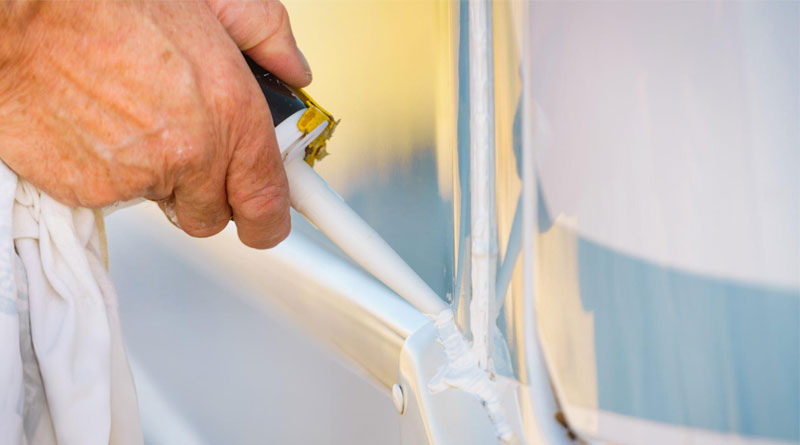
The most critical distinction when buying RV lap sealant is the difference between self-leveling and non-leveling (or “no-sag”) formulas. Self-leveling sealants are designed with low viscosity, meaning they are thin enough to flow and level out on their own. These are exclusively for horizontal surfaces like the top of your RV roof, where they can flow into screw heads and seams to create a flat, puddle-proof seal. Non-leveling sealants are thick and high-viscosity. They stay exactly where you put them, making them mandatory for vertical surfaces like sidewalls, windows, and the edges of the roof. Using a self-leveling sealant on a vertical door frame will result in a messy run down the side of your camper.
Matching Sealant to Roofing Materials
Not all sealants are compatible with every roof type. Most modern RVs use EPDM (Ethylene Propylene Diene Monomer) or TPO (Thermoplastic Polyolefin) rubber membranes. Some older or vintage models may have aluminum or fiberglass roofs. You must verify that the lap sealant you choose is compatible with your specific material. For example, some petroleum-based sealants can cause EPDM rubber to swell or degrade. Always look for sealants specifically labeled as “EPDM-safe” or “compatible with TPO.” Additionally, remember that almost no lap sealant will bond to existing silicone; if your RV was previously repaired with silicone, every trace must be removed before applying a new lap sealant.
Elasticity and UV Resistance
An RV is essentially a rolling earthquake. As you drive, the chassis flexes and the roof expands and contracts in the sun. If a sealant cures too hard, it will crack and pull away from the surface within a few hundred miles. The best RV lap sealants are formulated to remain permanently elastic. This “memory” allows the seal to stretch and compress without breaking its bond. Furthermore, because the roof is exposed to constant sunlight, UV resistance is vital. High-quality sealants include UV stabilizers to prevent the material from becoming brittle, chalky, or yellowed, which are the primary signs of sealant failure.
Temperature Application Ranges
The environment in which you apply the sealant matters just as much as where you travel. Some sealants require a minimum temperature of 40°F to cure properly, while others can be applied in temperatures as low as 0°F. If you are performing emergency repairs in the winter, a hybrid-technology sealant is often necessary. Similarly, apply sealant in direct, high-noon summer heat can cause “skinning” to happen too quickly, preventing the self-leveling action. Ideally, aim for a dry day with moderate temperatures to ensure the best possible adhesion and a smooth, professional finish.
Surface Preparation and Adhesion
No sealant can perform its job if the surface isn’t prepared correctly. Adhesion is the bond between the sealant and the roof, and it is easily compromised by dust, grease, or old, peeling caulk. Before applying any lap sealant, the area must be scrubbed with a specialized cleaner or denatured alcohol (check your manufacturer’s recommendation for EPDM). Some sealants are “one-step,” meaning they don’t require a primer, while others require an EPDM primer to ensure the bond is chemical as well as mechanical. Taking the time to prep the surface will double the lifespan of your repair.
Cure Time and Weather Protection
When you are on the road, you often don’t have days to wait for a product to dry. Check the “tack-free” or “set time” of the sealant. Many high-quality RV products set up within 30 to 60 minutes, which is enough to protect against a surprise rain shower. However, the “full cure” often takes 24 to 48 hours. If you plan on driving immediately after a repair, you need a sealant with a very fast initial grab to ensure the wind doesn’t pull the fresh bead away from the seam. Always plan your maintenance for a window of at least 24 hours of dry weather for the best results.
Color and Aesthetic Maintenance
While function is the priority, aesthetics still matter. Most RV lap sealants are white to match standard roof membranes, but some are available in grey, tan, or black to match different RV trim or roofing colors. Over time, many lap sealants can become “tacky” and attract road grime and dust, leading to black streaks or a dirty appearance. Look for sealants that are labeled as “low-tack” after curing or those that are sun-ray stabilized. Regularly washing your roof with an RV-safe roof cleaner can also help prevent the sealant from becoming a magnet for dirt.
Value and Quantity Planning
RV lap sealant is usually sold in 10-ounce tubes that fit into a standard caulking gun. A single tube typically covers about 20 to 25 linear feet with a standard 5/16″ bead. For a typical 30-foot RV, a full roof inspection and “touch up” of vents and seams usually require 4 to 6 tubes. It is always better to have an extra tube on hand than to run out in the middle of sealing a skylight. Buying in 4-packs or 6-packs often provides a significantly better price per tube and ensures you have enough material to do the job thoroughly without cutting corners.