Best RV Propane Regulators of 2026
Ensuring a steady and safe propane supply is crucial for any RV adventure. A reliable RV propane regulator is the unsung hero, maintaining consistent gas pressure for your appliances, from the stove to the water heater. Choosing the right one guarantees efficient operation and peace of mind on the road. Dive into our top picks for the best RV propane regulators to keep your journey smooth and your systems running flawlessly.
1. Stanbroil Horizontal Two Stage Propane Regulator

- Style: Horizontal
- Hose Type: 20″ Stainless Steel Braided ACME nut x 1/4″ male NPT
- Design: Double-stage for constant gas pressure
- Materials: High-strength, corrosion-resistant
The Stanbroil Horizontal Two Stage Propane Regulator offers a robust and reliable solution for single-tank RV setups. Its double-stage design is engineered to maintain a remarkably constant gas pressure, ensuring your RV appliances, from furnaces to stoves, operate efficiently regardless of demand fluctuations. The inclusion of a 20-inch stainless steel braided hose is a significant advantage, providing superior protection against damage and extending the overall service life compared to standard rubber hoses.
Crafted from high-strength, corrosion-resistant materials, this regulator is built for durability and longevity, promising years of dependable performance with minimal maintenance. The horizontal orientation offers a compact fit for various RV configurations, making it a practical choice for those prioritizing space and a secure, long-lasting connection to their propane tank. Its solid construction translates to peace of mind on the road.
- Pros:
- Durable stainless steel braided hose included
- Consistent gas pressure with dual-stage design
- High-strength, corrosion-resistant construction
- Cons:
- Designed for single tank use only
- No automatic changeover feature
2. BlueStars 2-Stage Auto Changeover RV Propane Regulator

- Certification: CSA C‑US certified (No.2055063)
- Capacity: Master 210,000BTU/Hr, Reserve 130,000BTU/Hr
- Hoses: Two 18″ Stainless Steel Braided Pigtails with Gauge
- Feature: Auto-changeover indicator (green to red)
The BlueStars Upgraded RV Propane Regulator is a top-tier choice for RVs with dual propane tanks, offering enhanced safety and convenience. It is CSA C-US certified, ensuring rigorous testing for pressure integrity, durability, and leak resistance, providing peace of mind during all your outdoor adventures. The dual-stage design ensures a constant gas pressure, while the automatic changeover feature seamlessly switches from an empty tank to a full one, indicated clearly from green to red, preventing any interruptions to your propane supply.
Durability is a key highlight, with two 18-inch stainless steel braided hoses featuring a four-layer construction that resists wear, corrosion, and harsh weather conditions. This robust design ensures leakproof gas transmission and extended service life. With excess flow protection and an automatic shut-off valve, this regulator prioritizes safety and allows precise control over your propane supply, making it a versatile and reliable solution for various propane-powered appliances in your RV, van, or trailer.
- Pros:
- CSA-certified for superior safety
- Automatic changeover for uninterrupted supply
- Durable, 4-layer stainless steel braided hoses
- Cons:
- Specific 1/4″ SAE inverted flare inlets
- 18-inch pigtails may be short for some setups
3. Flame King 2-Stage Horizontal Compact Regulator
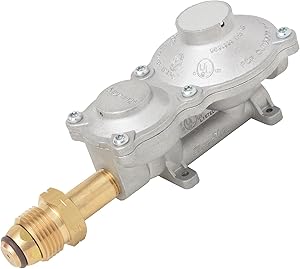
- Design: Dual-stage, horizontal
- Materials: Heavy-duty aluminum and solid brass
- Connections: POL Inlet, 3/8″-18NPT outlet
- Capacity: 160,000 BTU/HR
The Flame King 2-Stage Horizontal Super Compact Regulator is an excellent choice for RVs, food trucks, or generators that rely on a single propane tank, especially those with high BTU demands. Its dual-stage design is a standout feature, meticulously engineered to deliver a consistently smooth and stable flow of propane gas. This ensures all your appliances receive the optimal pressure, preventing performance issues that can arise from fluctuating gas supply.
Constructed from heavy-duty aluminum and solid brass, this regulator offers superior durability and ensures secure, leak-free connections to your tank. With a robust 160,000 BTU/HR capacity and a precise 11-inch water column pressure, it’s well-suited for larger vehicles or appliances demanding significant propane output. The POL inlet connection is standard for larger tanks, while the 3/8″-18NPT outlet ensures a reliable link to your RV’s main gas line, making it a dependable and compact solution for continuous, high-demand propane use.
- Pros:
- Dual-stage for consistent pressure
- Durable aluminum and brass construction
- High 160,000 BTU/HR capacity
- Cons:
- Single tank regulator only
- No auto-changeover feature
4. Flame King (KT12ACR-2) Propane Regulator

- Type: UL Listed 2-stage auto changeover
- Pigtails: Two 12-inch included
- Inlets/Outlet: 1/4″ SAE inverted flare / 3/8″ NPT female
- Capacity: Rated for 345,200 BTU
The Flame King KT12ACR-2 regulator is designed to simplify propane management for RVs equipped with dual tanks, ensuring a continuous and uninterrupted supply. Its primary advantage is the automatic changeover feature, which seamlessly switches from an empty primary tank to the reserve, allowing you to remove and refill the empty cylinder without disrupting your propane-powered appliances. This convenience is invaluable for extended trips, eliminating the need for manual intervention at inconvenient times.
As a UL Listed regulator, it meets high safety standards, and its dual-stage design guarantees consistent gas pressure under varying demands and conditions, optimizing the performance of your RV’s heating, cooking, and hot water systems. With a substantial 345,200 BTU rating, it can handle a wide range of appliance needs. The included two 12-inch pigtails offer a straightforward connection to your propane tanks, making installation relatively easy for most RV setups.
- Pros:
- Automatic changeover for uninterrupted propane
- UL Listed for assured safety standards
- High 345,200 BTU capacity
- Cons:
- 12-inch pigtail length may be short for some installations
- No integrated propane tank gauge
5. RecPro Propane Regulator

- Max Pressure: 250 PSI
- Capacity: 287,500 BTU
The RecPro RV Propane Gas Regulator is engineered for ultimate convenience and reliability, making it a standout choice for dual-tank RV owners. Its intelligent automatic changeover system eliminates the hassle of manually switching tanks; when one tank is depleted, the regulator seamlessly transitions to the full reserve tank, indicated by a clear red window. This ensures your propane supply remains uninterrupted, perfect for long trips or extended stays.
Built with high-quality, durable materials, this regulator is designed for long-lasting use, capable of handling a maximum working pressure of 250 PSI. Safety is paramount, with the included QCC1 hoses featuring a flow limiter and check valve to prevent leaks and ensure secure connections. With a robust 287,500 BTU capacity, it can reliably power a wide array of RV appliances. Its compact design, along with included pigtails, a mounting bracket, and cover, makes installation straightforward and keeps your propane setup neat and protected.
- Pros:
- Automatic changeover with clear indicator
- QCC1 hoses include safety features
- High 287,500 BTU capacity
- Cons:
- 11.5″ pigtail length may be short for some setups
- No integrated pressure gauge
6. Fairview GR-9984 RV Propane Regulator

- Type: 2-Stage Automatic Changeover
- Capacity: 345,000 BTU (service), 260,000 BTU (reserve)
- Outlet Pressure: 11″ water column
- Inlets/Outlet: Dual 1/4″ inverted flare / 3/8″ NPT female
The Fairview GR-9984 is a highly capable 2-stage automatic changeover regulator designed to provide an uninterrupted propane supply for RVs, campers, and travel trailers with dual tanks. Its key benefit lies in automatically switching from the service tank to the reserve tank when the primary runs empty, ensuring your cooking, heating, and hot water continue without any disruptions. This smart design simplifies propane management, allowing you to enjoy your trip without constantly monitoring tank levels.
Engineered for consistent low-pressure performance, this regulator reduces high tank pressure to a steady 11″ water column, delivering reliable propane flow to all your LP appliances. With an impressive capacity of up to 345,000 BTU (service tank) and 260,000 BTU (reserve tank) per hour, it’s particularly well-suited for high-demand setups, even performing robustly in cold temperatures. The clear color indicator instantly shows when the active tank is depleted, prompting timely refills. Its standard connection sizes make it compatible with common RV hookups.
- Pros:
- Automatic changeover for uninterrupted supply
- High BTU capacity, robust for cold weather
- Consistent 11″ WC low-pressure output
- Cons:
- Pigtail hoses are not included
- Mounting screws are not provided
7. Cavagna Kosan 924N RV Auto Changeover Regulator

- Inlets/Outlet: (2) 1/4″ Inverted Flare / 3/8″ Female NPT
- Capacity: 160,000 BTU
- Components: Stainless Steel Screws & Bolts
- Diaphragm: High temperature resistant
The Cavagna Kosan 924N RV Auto Changeover Regulator offers a dependable solution for managing dual propane tanks on your RV. Designed to automatically switch from an empty service tank to a full reserve tank, it ensures a seamless and uninterrupted propane supply for all your appliances. This automatic function is a great convenience, saving you from having to manually change tanks, especially during inconvenient times like cold nights or while cooking.
Constructed with durable components, including stainless steel screws and bolts, this regulator is built for longevity and reliability in varying outdoor conditions. A key feature is its high-temperature resistant diaphragm, which enhances safety and performance under operational stress. With a 160,000 BTU capacity, it’s suitable for many RV setups, delivering consistent gas pressure. The included ‘L’ bracket facilitates straightforward mounting, making it a practical choice for those seeking a robust and easy-to-install auto-changeover system.
- Pros:
- Automatic changeover for continuous propane flow
- Durable with stainless steel screws and bolts
- High temperature resistant diaphragm
- Cons:
- Pigtail hoses are not included
- 160,000 BTU capacity may be lower than some needs
How to Choose RV Propane Regulators
Propane is the lifeblood of many RVs, fueling everything from your stove and oven to your water heater and furnace. Without a properly functioning propane regulator, your RV’s essential systems can sputter, fail, or even become unsafe. A regulator’s job is simple yet critical: to reduce the high pressure of propane coming from the tank to a safe, consistent level that your appliances can use. This guide will walk you through everything you need to know to select the perfect RV propane regulator for your mobile home, ensuring a smooth and worry-free journey.
Understanding RV Propane Regulators
Before diving into specific features, it’s important to grasp the fundamental role and mechanism of a propane regulator. Imagine the immense pressure inside a full propane tank – it’s far too high for any RV appliance to handle directly. A regulator acts as a crucial intermediary, taking that high pressure and stepping it down to a manageable, consistent output, typically around 11 inches of water column (WC) or 0.4 PSI, which is the standard for most RV appliances. This precise control ensures efficient combustion, optimal appliance performance, and, most importantly, safety.
What is a Propane Regulator?
At its core, a propane regulator is a mechanical device that controls the flow and pressure of propane gas. It uses a diaphragm, spring, and valve system to respond to changes in demand. When an appliance calls for more propane, the pressure behind the diaphragm drops, allowing the valve to open further and release more gas. Conversely, if demand lessens, the pressure rises, pushing the diaphragm back and closing the valve slightly to maintain the set output pressure. This continuous adjustment is what keeps your propane supply steady.
Single-Stage vs. Two-Stage Regulators
Propane regulators come in two primary configurations: single-stage and two-stage.
- Single-Stage Regulators: These reduce tank pressure directly to the appliance’s operating pressure in one step. While simpler and often less expensive, they are generally less efficient at maintaining a constant pressure, especially as tank levels drop or demand fluctuates. They are best suited for small, single-appliance setups, like a portable grill, and are rarely recommended for an entire RV system due to their inability to handle varied demand consistently.
- Two-Stage Regulators: These are the standard for RVs and are highly recommended. They reduce pressure in two steps. The first stage brings the high tank pressure down to an intermediate pressure (e.g., 10-15 PSI), and the second stage further reduces it to the appliance’s operating pressure (e.g., 0.4 PSI). This two-step process provides much greater stability and consistency in gas flow, regardless of how much propane is in the tank or how many appliances are running. This ensures reliable performance for your furnace, water heater, and cooking range simultaneously.
Types of RV Propane Regulators
Beyond the single or two-stage design, RV regulators are further categorized by how they manage multiple propane tanks, a common setup in modern RVs.
Manual Changeover Regulators
If your RV has two propane tanks, a manual changeover regulator allows you to switch between them. When the primary tank runs empty, you manually turn a lever or knob to draw propane from the reserve tank. While functional, this requires you to be present and aware of the tank status, potentially leading to interruptions if a tank runs out unexpectedly during a cold night or mid-meal. They are typically more budget-friendly but less convenient.
Automatic Changeover Regulators
The preferred choice for most RVers with dual tanks, an automatic changeover regulator eliminates the need for manual switching. It intelligently senses when the primary tank is depleted and automatically draws propane from the reserve tank. Most models feature a clear indicator (often red when empty, green when full) to show which tank is currently in use and when it’s time to refill the empty one. This system ensures an uninterrupted propane supply, offering maximum convenience and peace of mind.
Essential Features to Consider When Buying
Selecting the best RV propane regulator involves evaluating several key features to match your RV’s specific needs and your usage habits.
BTU Capacity and Appliance Needs
The British Thermal Unit (BTU) capacity of a regulator indicates how much propane it can deliver per hour. You need to ensure the regulator’s capacity exceeds the combined BTU demand of all your RV’s propane appliances if they were all running simultaneously. Check the BTU ratings on your furnace, water heater, stove, and any other propane-powered devices. A common mistake is choosing a regulator with too low a BTU capacity, which can lead to low pressure, flickering flames, and underperforming appliances. Most RV two-stage regulators have capacities ranging from 160,000 BTU/Hr to over 300,000 BTU/Hr, which is generally sufficient for typical RVs.
Tank Connection Type
RV propane tanks typically use one of two main connection types:
- QCC1 (Type 1): This is the most common, modern connection. It features a large, green or black plastic handwheel, incorporates an excess flow device for safety, and requires no wrench to connect.
- POL (Prest-O-Lite): This older connection type typically uses a left-hand thread and often requires a wrench to tighten. While still found on some older tanks or larger commercial cylinders, most new RVs and tanks use QCC1. Ensure your regulator’s pigtail hoses match your tank connections.
Hose Quality and Length
The hoses that connect your regulator to the propane tanks are crucial.
- Material: Stainless steel braided hoses are highly recommended. They offer superior durability and resistance to kinking, cuts, abrasion, and rodent damage compared to standard rubber hoses, extending service life and enhancing safety.
- Length: Pigtail hoses commonly come in lengths from 12 to 24 inches. Ensure the length is appropriate for your RV’s tank mounting system, allowing for flexible connection without being excessively long or taut. Some regulators come with hoses, while others require separate purchase.
Inlet and Outlet Connections
Pay close attention to the regulator’s inlet and outlet port sizes.
- Inlet: For dual-tank systems, inlets are usually 1/4″ SAE inverted flare to connect to pigtail hoses. Single-tank regulators may have a POL or ACME nut direct connection.
- Outlet: The main outlet to your RV’s gas line is typically 3/8″ NPT (National Pipe Thread) female pipe thread. Always verify these specifications to ensure compatibility with your existing RV plumbing.
Safety Features
Modern regulators incorporate several safety features:
- Excess Flow Device: Built into QCC1 connections, it restricts gas flow in case of a major leak or hose rupture.
- Pressure Relief Valve: Vents excess pressure safely if the regulator malfunctions.
- Automatic Shut-off: Some regulators include a shut-off valve to prevent leaks during tank changes or if a hose is disconnected.
Indicators and Gauges
For automatic changeover regulators, a clear visual indicator (e.g., green/red) is vital for knowing which tank is active and when it’s empty. Some pigtail hoses also include integrated gauges that give a visual indication of propane levels, though these are typically simple “full/low” indicators rather than precise percentage readings.
Durability and Materials
Look for regulators constructed from high-quality, corrosion-resistant materials like heavy-duty aluminum and solid brass. These materials ensure longevity and reliable performance in various weather conditions, protecting against rust and wear.
Certifications
Always choose regulators that are certified by recognized safety organizations such as CSA (Canadian Standards Association) or UL (Underwriters Laboratories). These certifications confirm that the product has been rigorously tested and meets stringent safety and performance standards for propane components.
Installation, Maintenance, and Troubleshooting
Even with the best regulator, proper installation and routine care are essential for safe and efficient operation.
Installation Considerations
While installing an RV propane regulator can be a DIY task for experienced individuals, it’s often best left to a qualified RV technician. Propane is highly flammable, and leaks can be extremely dangerous. If you do it yourself, ensure all connections are tight, use thread sealant specifically designed for propane, and always perform a leak test using a soapy water solution (looking for bubbles) before using your system.
Regular Maintenance for Longevity
- Inspect Hoses: Routinely check pigtail hoses for cracks, fraying, bulges, or signs of rodent damage. Replace them immediately if any damage is found.
- Clean Vents: Ensure the regulator’s vent hole (typically on the underside) is clear of debris or insect nests. Blocked vents can lead to improper pressure regulation.
- Check Connections: Periodically ensure all connections are snug and leak-free.
- Regulator Lifespan: While not a hard-and-fast rule, many experts recommend replacing RV propane regulators every 10-15 years, or sooner if performance issues arise, as internal diaphragms and springs can wear out over time.
Common Troubleshooting Tips
- Low Pressure/Flickering Flames:
- Check if a tank is empty or nearly empty.
- Ensure the excess flow device hasn’t been tripped (often happens if the tank valve is opened too quickly; close it, wait a minute, then open slowly).
- Inspect for blockages in the pigtail hoses or regulator vent.
- No Gas Flow:
- Verify tank valves are fully open.
- Check for an active excess flow device.
- Ensure the regulator’s auto-changeover switch (if applicable) is functioning correctly.
- Propane Smell: This indicates a leak and is a serious safety concern. Immediately shut off all propane tanks, extinguish all flames, ventilate the RV, and have the system inspected by a professional before further use.
Conclusion
Choosing the best RV propane regulator is a crucial decision for the safety and functionality of your RV. Prioritize a two-stage automatic changeover regulator for dual-tank setups to ensure consistent pressure and uninterrupted supply. Pay close attention to BTU capacity, hose material, connection types, and critical safety certifications like CSA or UL. By investing in a high-quality regulator and performing routine maintenance, you can enjoy peace of mind and reliable propane service throughout all your RV adventures. Don’t compromise on this vital component; a small investment in the right regulator translates to significant safety and convenience on the road.