Best Solar Generators For RV of 2025
Solar generators offer a clean, quiet, and sustainable solution, transforming sunlight into dependable electricity for all your on-the-go needs. Choosing the right unit, however, involves understanding key features like capacity, output, charging speed, and portability. This guide will help you navigate the options to find the best solar generator to enhance your RV experience, ensuring uninterrupted comfort and convenience wherever the road takes you.
1. Anker SOLIX C1000 Gen 2 Portable Power Station

- Capacity: 1,024Wh LiFePO4 Battery
- AC Output: 2,000W (3,000W Peak) via 10 Ports
- Recharging Speed: 49 Min UltraFast AC / 1.8 Hr Solar (600W max)
- Lifespan: 10 Years (4,000 cycles to 80%)
The Anker SOLIX C1000 Gen 2 stands out as an exceptional choice for RV enthusiasts seeking robust and rapid power. Its 1,024Wh LiFePO4 battery, known for its longevity and safety, promises a remarkable 10 years of daily use, maintaining over 80% capacity even after 4,000 charge cycles. With a continuous 2,000W output (and a 3,000W peak), this unit can effortlessly power up to 10 devices simultaneously, handling everything from microwaves to laptops. The compact and portable design, being 14% smaller and 11% lighter than comparable models.
What truly sets the Anker SOLIX C1000 Gen 2 apart is its charging versatility and speed. The upgraded HyperFlash technology allows for an ultrafast AC recharge, reaching full capacity in just 49 minutes at 1,600W. For off-grid adventures, it supports up to 600W of solar input, enabling a full recharge in a mere 1.8 hours, granting true energy independence. Additionally, its 10ms UPS backup feature is invaluable for sensitive equipment like CPAP machines or vital electronics.
- Pros:
- Ultra-fast AC recharging in 49 minutes
- High 2,000W output powers most RV appliances
- Compact and significantly lighter than competitors
- Cons:
- Solar panels are optional and not included
- 600W maximum solar input might be limiting for larger arrays
2. BLUETTI Solar Generator Elite 100 V2

- Capacity: 1,024Wh
- AC Output: 1,800W (2,700W Lifting Power) via 11 Ports
- Solar Charging: 2x100W panels included, full in 6.8 hrs (Up to 1000W input)
- Portability: 25 lbs, 35% Smaller, 30% Lighter
The BLUETTI Solar Generator Elite 100 V2 emerges as a highly optimized and convenient power solution specifically designed for RVers and outdoor enthusiasts. A significant advantage of this kit is the inclusion of two 100W portable solar panels, allowing you to start generating clean energy right out of the box and achieve a full charge in approximately 6.8 hours. Its 1,024Wh capacity paired with an 1800W AC output (featuring 2700W Lifting Power for surge demands) ensures you can reliably power up to 11 devices, catering to essential RV appliances, remote work setups, or camping electronics.
Beyond its impressive power delivery and portability, the Elite 100 V2 is engineered for seamless integration into your RV life. It offers reliable emergency backup, with an instant switchover during power outages to protect crucial devices like Wi-Fi routers or laptops, ensuring uninterrupted connectivity. Operating at a library-level 30dB, it maintains a remarkably quiet environment, a huge plus for peaceful nights at the campsite. The system also supports higher-wattage solar inputs, allowing for up to 1000W if you choose to expand with additional panels, drastically cutting down recharge times to as little as 70 minutes.
- Pros:
- Two 100W portable solar panels included
- Exceptionally compact and lightweight design
- Strong 1800W AC output with Lifting Power
- Cons:
- Solar panels are shipped separately from the unit
- Full 1000W solar input requires additional panel purchases
3. EF ECOFLOW DELTA Pro Portable Power Station

- Capacity: 3600Wh LFP Battery (Expandable to 25kWh)
- AC Output: 3600W (4500W with X-Boost) via 15 Ports
- Recharging Speed: 1.8 Hr (240V) / 2.7 Hr (1800W Wall) / 2.8 Hr (4x400W Solar)
- Charging Methods: AC, Solar, Car, EV Station, Smart Generator
The EF ECOFLOW DELTA Pro is a monumental power solution for RV owners who demand uncompromising capacity and versatility. Boasting a massive 3600Wh LFP battery, this powerhouse ensures you have ample energy for extended off-grid living, comfortably running high-demand appliances that most smaller generators simply can’t handle. Its single unit delivers an impressive 3600W AC output, expandable to 4500W with X-Boost technology, and can even be paired with a second unit for an astounding 7200W.
The DELTA Pro excels not just in capacity and output but also in its industry-leading X-Stream fast charging. You can fully recharge this beast in an incredible 1.8 hours via 240V outlets, 2.7 hours from a standard 1800W wall outlet, or achieve a full solar charge in just 2.8 hours with four 400W solar panels. Its unparalleled five ways to charge – including EV station charging, a unique feature for a portable power station – offer ultimate flexibility.
- Pros:
- Massive 3600Wh capacity, expandable to 25kWh
- Extremely high 3600W AC output (4500W X-Boost)
- Industry-leading X-Stream ultra-fast charging
- Cons:
- High capacity means it’s a larger and heavier unit
- Solar panels are not included with this base unit
4. Jackery Explorer 1000 v2 Portable Power Station

- Capacity: 1,070Wh LiFePO4 Battery
- AC Output: 1,500W (3,000W Surge) via 3 Ports
- Recharging Speed: 1 Hr (Emergency Mode via App) / 1.7 Hr (Default)
- Lifespan: 10 Years (4,000 cycles to 70%)
The Jackery Explorer 1000 v2 Portable Power Station offers a compelling blend of power and portability for RVers, campers, and those needing reliable off-grid energy. Despite its powerful 1,500W AC output (with a 3,000W surge peak), which can handle most essential RV appliances like mini-fridges and electric kett, it remains remarkably compact and lightweight at just 23.8 lbs. This makes it an excellent companion for road trips, easily moved from your RV to a picnic spot. Its 1,070Wh LiFePO4 battery ensures a long-lasting and safe power source, engineered to maintain over 70% capacity after 4,000 charge cycles, providing a lifespan exceeding 10 years for consistent, worry-free use.
One of the standout features of the Explorer 1000 v2 is its rapid charging capability. With ChargeShield 2.0 technology, you can activate an emergency charging mode via the Jackery App to achieve a full 0% to 100% charge in a mere one hour, ideal for quick top-ups before hitting the road. The default charging takes a still impressive 1.7 hours, optimized for battery health. Versatility is also key, with three pure sine wave AC ports, two 100W USB-C ports, one USB-A port, and a DC car port, ensuring all your devices, from laptops to smartphones, can be powered simultaneously. The smart app control further enhances the user experience, allowing you to switch between charging modes and monitor performance effortlessly.
- Pros:
- Powerful 1,500W AC output in a compact design
- Remarkably fast 1-hour emergency charging
- Exceptional 10-year lifespan with LFP battery
- Cons:
- Solar panels are optional and not included
- 1-hour fast charge requires app activation each time
5. EF ECOFLOW DELTA Pro Solar Generator
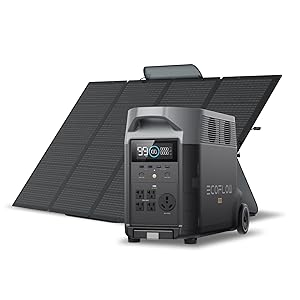
- Capacity: 3600Wh (Expandable)
- AC Output: 3600W (4500W with X-Boost) via 15 Ports
- Solar Panel: 400W foldable, 22.4% efficiency, IP68 rated
- Solar Recharge: 11 Hrs with 1x400W panel / 3.5 Hrs with 3x400W panels
This EF ECOFLOW DELTA Pro bundle offers the ultimate in off-grid power for RVers, combining the colossal 3600Wh DELTA Pro power station with a high-efficiency 400W portable solar panel. The DELTA Pro itself is a powerhouse, delivering 3600W AC output (expandable to 4500W with X-Boost) through 15 versatile outlets, capable of running almost any appliance in your RV, from air conditioners to electric grills. Its massive capacity ensures prolonged power supply for extended adventures, and its expandability means you can always grow your system if your needs increase. The inclusion of the 400W foldable solar panel transforms this into a true solar generator.
The accompanying 400W portable solar panel is a marvel of engineering, boasting a 22.4% conversion efficiency to capture maximum sunlight, even in varying conditions. Its light and durable design, weighing just 35.3 lbs and coming with an adjustable carry case, makes it incredibly easy to transport, set up, and pack away. With an IP68 waterproof rating, you can trust it to perform reliably whether it’s sunny or rainy, essential for unpredictable outdoor conditions. The intelligent EcoFlow app control further enhances the experience, allowing you to monitor and manage all aspects of your power station remotely via Wi-Fi or Bluetooth, ensuring optimal energy usage throughout your RV journey.
- Pros:
- High-capacity 3600Wh power station included
- Powerful 3600W AC output handles heavy appliances
- Comes with a high-efficiency 400W portable solar panel
- Cons:
- Power station and solar panel delivered in separate packages
- Recharging with only one 400W panel takes 11 hours
6. DABBSSON 2048Wh Portable Power Station

- Capacity: 2048Wh Semi-Solid LiFePO4 Battery
- AC Output: 2,200W (3,300W P-Boost) via 6 AC Outlets
- Portability: 41 lbs, 11.2 × 18.3 × 8.9 in (Ultra-Compact)
- Recharging Speed: 80% in 1.5 Hrs (1500W AC) / Up to 800W Solar Input
The DABBSSON 2048Wh Portable Power Station redefines expectations for high-capacity generators with its ultra-compact and lightweight design, making it an exceptional choice for RVers who value both power and space efficiency. Delivering a substantial 2kWh of energy within an 11.2 × 18.3 × 8.9-inch frame and weighing just 41 lbs, it’s significantly smaller and lighter than many competitors in its class. This impressive feat is achieved through advanced semi-solid LiFePO4 cells and an AI-driven BMS, contributing to 1.3X longer runtime and an outstanding 4000+ charge cycles, ensuring over a decade of reliable performance for your RV adventures.
With a robust 2200W rated output and an impressive 3300W P-Boost capability, the Dabbsson 2000L can power up to 12 devices simultaneously, including power-hungry tools, outdoor equipment, and multiple electronics, making it ideal for comprehensive RV setups or remote work. Its ultra-fast charging capabilities are equally impressive, reaching 80% in just 1.5 hours via 1500W AC input, or staying charged off-grid with up to 800W solar input (MPPT supported).
- Pros:
- Ultra-compact and lightweight for its capacity
- Advanced semi-solid LiFePO4 battery for extended runtime
- High 2200W output with 3300W P-Boost for heavy loads
- Cons:
- Solar panels are not included with the unit
- Maximum 800W solar input might require multiple high-wattage panels
7. EBL Portable Power Station 1000W

- Capacity: 999Wh Lithium Battery
- AC Output: 1000W (2000W Peak) via 2 AC Outlets
- Charging Solutions: Solar (6-8 hrs), Car (8-10 hrs), AC Wall (6-9 hrs)
- Ports: 9 ports including 10W Wireless Charging & 60W USB-C PD
The EBL Portable Power Station 1000W offers a versatile and highly convenient power solution for RVers, campers, and anyone needing reliable off-grid energy. With a robust 999Wh capacity and a continuous 1000W AC output (peaking at 2000W), it’s capable of powering a wide range of devices, from laptops and mini-fridges to projectors, ensuring comfort and utility during power outages or outdoor adventures. What truly sets this unit apart is its exceptional 9-port versatility, which includes two 500W AC outlets, dedicated DC ports, USB-A and 60W USB-C PD ports, a car socket, and a standout 10W wireless charging pad.
Designed for eco-friendly power, the EBL 1000W provides triple fast-charging solutions: it can be fully recharged in 6-8 hours via solar panels, 8-10 hours from a car outlet, or 6-9 hours from a standard AC wall outlet, offering flexible and clean alternatives to traditional gasoline generators. Its lightweight and portable design is a significant advantage for RV living, weighing only 18.65 lbs, with a 43% lighter and 30% more space-saving profile than many competitors.
- Pros:
- 1000W AC output handles a variety of devices
- Exceptional 9-port versatility, including wireless charging
- Triple fast-charging methods for flexible power input
- Cons:
- Lower capacity (999Wh) compared to some larger units
- Solar panels are not included with the purchase
How to Choose the Best Solar Generators For Rv
Embarking on an RV adventure offers unparalleled freedom, but true independence often hinges on a reliable power source. Solar generators have emerged as a game-changer for RV enthusiasts, providing a clean, quiet, and sustainable way to power your home on wheels. Unlike traditional gas generators, solar generators harness the sun’s energy, converting it into usable electricity for all your appliances and devices. This eliminates the need for noisy engines, constant fuel refills, and exhaust fumes, contributing to a more enjoyable and eco-friendly camping experience. However, with a growing market full of options, selecting the best solar generator for your RV can feel overwhelming. This comprehensive guide will walk you through the essential factors to consider, helping you make an informed decision that perfectly matches your RV lifestyle and energy needs.
Key Factors to Consider
When investing in a solar generator for your RV, several critical factors come into play. Understanding these will help you narrow down your choices and find a unit that delivers the performance and reliability you need for your travels.
Capacity (Wh)
The capacity, measured in Watt-hours (Wh), indicates how much energy the generator can store. This is arguably the most crucial specification for RVers, as it dictates how long your appliances can run on a single charge. A higher Wh rating means more stored energy and longer runtimes for your devices. For casual weekend trips with minimal power needs, a 500-1000Wh generator might suffice. However, for extended boondocking, running larger appliances, or maintaining a remote work setup, you’ll likely need a unit with 2000Wh or more, potentially with expandability options.
Output Power (W)
Output power, measured in Watts (W), refers to the maximum power the generator can deliver at any given moment. This is crucial for powering specific appliances. Check the wattage requirements of your most power-hungry devices – like microwaves, coffee makers, or air conditioners. Ensure the solar generator’s continuous AC output matches or exceeds these needs. Many generators also list a “peak” or “surge” wattage, which is the brief burst of power available for starting motors, like those in refrigerators. Confirming both continuous and peak output will prevent tripped circuits and ensure your appliances function smoothly.
Battery Type (LiFePO4 vs. Lithium-ion)
Most modern solar generators use either Lithium-ion (NMC) or Lithium Iron Phosphate (LiFePO4) batteries. LiFePO4 batteries are increasingly popular for RV applications due to their superior lifespan (typically 2,500-6,000 cycles to 80% capacity), enhanced safety, and better performance in varying temperatures. While Lithium-ion (NMC) batteries often offer a higher energy density, making them lighter for the same capacity, their lifespan is generally shorter (500-1,000 cycles). For long-term RV use, the durability and safety of LiFePO4 often make it the preferred choice, despite a slightly higher upfront cost or weight.
Charging Speed and Methods
How quickly and in what ways you can recharge your solar generator is vital. Look for generators that offer multiple charging inputs: AC wall outlet for home or campground charging, car 12V adapter for on-the-go top-ups, and crucially, solar panel input for off-grid recharging. Fast-charging technology via AC is a significant convenience, reducing downtime. For solar charging, check the maximum solar input wattage (e.g., 200W, 600W, 1000W) and look for Maximum Power Point Tracking (MPPT) controllers, which optimize solar input efficiency, especially important on cloudy days or when panels are not ideally positioned.
Portability and Size
Space in an RV is always at a premium, and you’ll likely be moving your generator around. Consider the physical dimensions and weight of the unit. While larger capacities often mean larger generators, some manufacturers excel at creating compact yet powerful devices. Look for integrated handles or even wheels on larger units. A generator that is too heavy or bulky will detract from the convenience of having portable power.
Number and Type of Ports
A good solar generator should offer a variety of output ports to accommodate all your devices. This typically includes multiple AC outlets (pure sine wave is essential for sensitive electronics), USB-A ports (including quick charge), USB-C Power Delivery (PD) ports for fast-charging laptops and phones, and 12V DC ports (like a car cigarette lighter socket). The more diverse the port selection, the less likely you are to need adapters or struggle to charge all your gear simultaneously.
Durability and Weather Resistance
Your solar generator will be used outdoors, exposed to varying elements. Look for models with robust construction, capable of withstanding bumps and minor impacts common during travel. While few are fully submersible, an IP rating (e.g., IP65, IP68 for solar panels) indicating resistance to dust and water splashes is a significant plus, ensuring reliability in light rain or dusty environments.
Expandability and Features
Some solar generators allow you to expand their capacity by adding extra battery packs, offering flexibility as your power needs grow. Other useful features include an Uninterruptible Power Supply (UPS) function for seamless power transfer during outages (though true UPS is rare in consumer models, many offer a fast EPS switchover), smart app control via Wi-Fi or Bluetooth for remote monitoring and management, and integrated LED lights for emergencies. These features can significantly enhance convenience and utility.
Warranty and Customer Support
A solar generator is a significant investment. Look for brands that offer a substantial warranty period (typically 2-5 years) and have a reputation for responsive customer service. This provides peace of mind, knowing you’re covered if any issues arise.
Calculating Your RV Power Needs
Before you can choose a generator, you need to understand how much power your RV consumes. This calculation is crucial to ensure you select a unit with adequate capacity and output.
List Your Appliances
Start by making a comprehensive list of all the electrical devices you plan to use in your RV. Include everything from your phone charger, lights, and fans to your refrigerator, microwave, coffee maker, TV, and any medical equipment like CPAP machines.
Determine Wattage and Run Time
For each item on your list, find its wattage (W) consumption. This information is usually found on the appliance label, in the user manual, or by searching online. Next, estimate how many hours per day you plan to use each appliance. For items like a refrigerator that run intermittently, estimate its “active” running time over 24 hours (e.g., 8 hours out of 24).
Calculate Daily Watt-Hours (Wh)
Multiply the wattage of each appliance by its estimated daily run time in hours. This gives you its daily Watt-hour (Wh) consumption. Sum up the Wh for all your appliances to get your total estimated daily Wh consumption. For example, a 100W TV used for 3 hours equals 300Wh. A 60W CPAP machine used for 8 hours equals 480Wh. A 1000W microwave used for 0.1 hours (6 minutes) equals 100Wh.
Add a Buffer
It’s always wise to add a 20-30% buffer to your total daily Wh calculation. This accounts for inefficiencies, unexpected usage, or colder temperatures that can affect battery performance. This buffer ensures you don’t run out of power prematurely and have a comfortable margin.
Understanding Solar Panel Integration
A solar generator is only as good as its ability to recharge, and for RVers, solar panels are the primary means of sustainable replenishment.
Panel Wattage and Efficiency
The wattage of your solar panels determines how much power they can generate. Higher wattage panels will charge your generator faster. Panel efficiency, usually expressed as a percentage, indicates how much of the sunlight hitting the panel is converted into electricity. High-efficiency panels (typically 20-23%) are beneficial in limited space or sub-optimal conditions. Consider foldable, portable solar panels for RVs, as they are easy to deploy, reposition for optimal sun exposure, and store when not in use.
Charge Controller Compatibility
Most quality solar generators come with an integrated MPPT (Maximum Power Point Tracking) charge controller. This is crucial as MPPT controllers are far more efficient than older PWM (Pulse Width Modulation) controllers, especially when connecting multiple panels or in varying light conditions. Ensure your chosen generator’s solar input specifications (voltage and wattage) are compatible with the solar panels you plan to use.
Placement and Setup
For optimal charging, solar panels need direct, unobstructed sunlight. In an RV setting, this means they often need to be portable so you can position them away from your RV’s shadow or surrounding trees. Consider the length of the solar charging cable, the ease of setup and takedown, and how securely they can be placed to prevent theft or damage.
Budgeting for Your Solar Generator
Solar generators vary widely in price, from a few hundred dollars for smaller units to several thousand for high-capacity, feature-rich models. Your budget will inevitably influence your choice, but remember to consider it an investment in your RV independence and comfort. Factor in the cost of any additional solar panels you might need if they aren’t included with the generator. While tempting to opt for the cheapest option, compromising too much on capacity or output might lead to frustration down the road. Aim for the best balance of features, capacity, and price that meets your calculated power needs.
Installation and Maintenance Tips
Solar generators require minimal “installation” compared to fixed RV solar systems, but proper setup and maintenance are key to longevity.
- First Charge: Always fully charge your new solar generator before its first use.
- Optimal Panel Placement: When using solar panels, position them to face the sun directly. Adjust them throughout the day for maximum efficiency.
- Storage: Store your generator in a cool, dry place when not in use. For LiFePO4 batteries, storing them at around 50-80% charge is often recommended for long-term health.
- Cleanliness: Keep the generator’s ports and vents free of dust and debris. Clean solar panels regularly to ensure maximum light absorption.
- Avoid Overloading: Always stay within the generator’s continuous and peak output limits to prevent damage or safety issues.
- Firmware Updates: If your generator has smart app control, regularly check for and install firmware updates to ensure optimal performance and access to new features.
Conclusion
Choosing the best solar generator for your RV is an empowering decision that unlocks a new level of freedom and self-sufficiency on the road. By carefully considering your specific power needs, understanding the key technical specifications, and evaluating the various features and charging options available, you can select a unit that perfectly complements your adventurous lifestyle. From compact powerhouses for weekend warriors to high-capacity behemoths for full-time boondockers, there’s a solar generator designed to meet every RVer’s demands. Embrace the quiet hum of renewable energy, reduce your environmental footprint, and enjoy uninterrupted power wherever your travels may lead you.