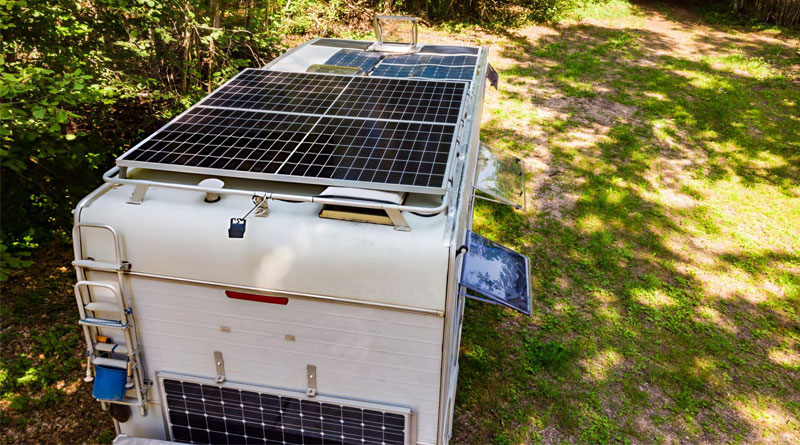
Best Solar Panels For RV Boondocking of 2025
Choosing the right solar setup is crucial for keeping your lights on, devices charged, and essential appliances running smoothly without the constant hum of a generator. This guide will illuminate the key factors to consider when selecting the best solar panels for your RV boondocking needs, ensuring you have ample power to extend your adventures further into the wild. Prepare to harness the sun’s energy and elevate your off-grid experience.
1. GRECELL 100W Portable Solar Panel

- Power Output: 100W, 20V
- Efficiency: Up to 23.5% (monocrystalline)
- Compatibility: Multiple DC adapters (8mm, 5.5*2.5mm, 3.5*1.35mm, 5.5*2.1mm) + Anderson Cable
- Material: Waterproof Oxford cloth, ETFE lamination
The GRECELL 100W Portable Solar Panel stands out as a versatile and efficient solution for RV boondockers and outdoor enthusiasts seeking reliable off-grid power. Designed with high-efficiency monocrystalline solar cells, it boasts an impressive conversion rate of up to 23.5%. Its comprehensive connectivity options, including multiple DC adapters and an Anderson cable, make it compatible with nearly all popular solar generators and portable power stations on the market. The built-in smart chip further optimizes charging speed while safeguarding your devices against overcharging and overloading.
Portability is a cornerstone of the GRECELL 100W panel. Its lightweight, bifold design, coupled with a zippered accessory pouch, makes transport and storage effortless, folding down compactly like a briefcase. Integrated kickstands allow for easy positioning to catch optimal sunlight, and reinforced grommets offer additional mounting options on RVs or tents. Constructed from durable, waterproof Oxford cloth and protected by ETFE lamination, this panel is built to withstand the rigors of outdoor use. Furthermore, its ability to combine with another panel for increased power output adds scalability.
- Pros:
- High conversion efficiency (23.5%)
- Wide compatibility with power stations
- Foldable, portable design with kickstands
- Cons:
- 100W might be low for heavy users
- No USB ports directly on panel
2. Renogy 400W Portable Solar Panel Suitcase

- Power Output: 400W
- Efficiency: 23% (A+ monocrystalline cells)
- Folded Dimensions: 33.7″x27.95″
- Weight: 30.2 lbs
The Renogy 400W Portable Solar Panel Suitcase is a formidable power solution designed for serious RV boondockers and off-grid adventurers who require significant energy output without sacrificing portability. Despite its high wattage, this panel folds down to a remarkably compact 33.7″x27.95″ and weighs just 30.2 lbs. Its setup is impressively swift, taking less than a minute with no tools required, thanks to sturdy, rust-proof kickstands that ensure stable positioning.
Constructed with premium materials, including reinforced fiberglass and an ETFE coating, the Renogy 400W panel is built for longevity and reliability in harsh outdoor conditions. The ETFE surface enhances UV resistance and waterproofing (IP67-rated), protecting the high-efficiency A+ monocrystalline cells, which maintain 23% efficiency even after years of use. An aluminum backsheet prevents overheating, further extending its lifespan. A standout feature is its parallel wiring design, which ensures uninterrupted power generation even when parts of the panel are under partial shading – a common challenge in wooded boondocking locations.
- Pros:
- Very high 400W power output
- Compact and lightweight for its wattage
- Extremely quick, tool-free setup
- Cons:
- Higher price point
- Still larger than smaller portable panels
3. ECO-WORTHY 200W Monocrystalline RV Solar Panel Kit
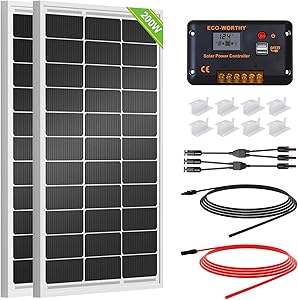
- Power Output: 200W (2x 100W panels)
- Efficiency: Up to 21.5% (monocrystalline)
- System Voltage: 12V/24V (with included 30A PWM controller)
- Dimensions (per panel): 35.2″ x 23.1″ x 1.37″
The ECO-WORTHY 200 Watts Solar Panel Kit provides a comprehensive and efficient solution for RV boondockers looking for a fixed or semi-permanent solar setup. This kit includes two 100W high-efficiency monocrystalline solar panels, capable of delivering up to 21.5% conversion efficiency. The package is truly “complete and easy,” offering everything needed for immediate installation: a 30A PWM charge controller, Z mounting brackets, 16.4ft 10 AWG solar cables, 2-in-1 connectors, and a 4.92ft tray cable. This all-inclusive approach makes it an excellent choice for DIY enthusiasts or those seeking a hassle-free setup for their RV, camper, or caravan.
Designed for durability, the ECO-WORTHY panels feature corrosion-resistant aluminum alloy frames, allowing them to withstand harsh weather conditions including strong winds (2400Pa) and heavy snow loads (5400Pa). The IP65-rated junction box provides robust protection against environmental elements. The flexibility of connecting the panels in series for 24V systems or parallel for 12V systems, alongside the included charge controller, allows for adaptable power management tailored to your specific battery bank requirements.
- Pros:
- Complete kit with all installation components
- Durable, weather-resistant fixed panels
- High monocrystalline cell efficiency
- Cons:
- Not a portable, foldable solution
- PWM controller less efficient than MPPT
4. DOKIO 300W Portable Foldable Solar Panel Kit
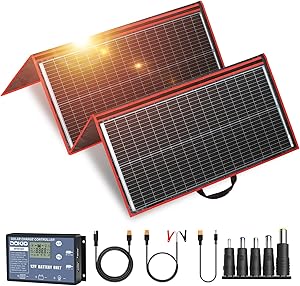
- Power Output: 300W
- Folded Dimensions: 19.3″ x 37.4″ x 1.1″
- Weight: 15.2 lbs
- Cable Length: 9.85ft (3m)
The DOKIO 300W Portable Foldable Solar Panel Kit offers a robust power solution for RV boondockers who need substantial wattage in a highly portable package. Weighing a mere 15.2 lbs and folding down to a compact 19.3×37.4×1.1 inches, this panel delivers serious energy output while remaining exceptionally easy to transport, mount, or store. Its lightweight design makes it an ideal companion for vans, boats, RVs, and emergency backup scenarios where space and mobility are key considerations. The high-grade monocrystalline cells ensure better conversion efficiency, capturing more sunlight for faster charging even in less-than-ideal conditions.
A standout feature is the inclusion of a separate PWM controller, which provides crucial protection against reverse polarity, overcharge, overload, and short-circuit, enhancing the safety and longevity of your 12V battery system. This separate controller can also be easily replaced or upgraded, offering future flexibility. The generous 9.85ft (3m) cable allows for flexible panel placement in direct sunlight while keeping your controller or power station safely shaded.
- Pros:
- High 300W output for its weight
- Very portable and lightweight
- Includes separate, protective PWM controller
- Cons:
- PWM controller is less efficient than MPPT
- Power station input limits may restrict full 300W
5. Renogy 200W Portable Solar Panel E.Flex

- Power Output: 200W
- Efficiency: 25% (16BB N-Type cell technology)
- Folded Dimensions: 23.72″ x 22.99″ x 1.97″
- Weight: 13.89 lbs
The Renogy 200W Portable Solar Panel, part of their E.Flex series, is an advanced and remarkably efficient power solution for RV boondockers prioritizing performance and portability. Boasting an industry-leading 25% efficiency thanks to upgraded 16BB N-Type cell technology, it significantly outperforms standard panels, delivering more power from the same amount of sunlight. This higher efficiency is particularly beneficial in limited spaces or during cloudy conditions, ensuring faster energy generation and a higher daily output for charging batteries or running appliances. Its certification to UL 61730 standards also provides assurance of safety and reliability for your off-grid power needs.
Weighing just 13.89 lbs, this is one of the lightest 200W panels in its class, folding down to a backpack-friendly size of 23.72 x 22.99 x 1.97 inches. The innovative magnetic closure simplifies setup and storage, a notable upgrade from traditional snap or Velcro designs. Beyond MC4 output for power stations and 12V battery systems, it features versatile charging capabilities with 1 USB-C PD (45W max) and 2 USB-A ports (18W & 15W). The stable, adjustable kickstands (40°/ 50°/ 60° angles) and IP65-rated, dust and splash-proof construction ensure robust performance in diverse outdoor environments.
- Pros:
- Industry-leading 25% efficiency
- Extremely lightweight and compact
- Multiple direct USB charging ports (USB-C PD, USB-A)
- Cons:
- Premium price point
- 200W might be insufficient for very high demands
6. DOKIO 200W Portable Foldable Solar Panel Kit

- Power Output: 200W
- Folded Dimensions: 20″ x 27″ x 1.1″
- Weight: 9.7 lbs
- Cable Length: 9.84ft (3m)
The DOKIO 200W Portable Foldable Solar Panel Kit is an excellent choice for RV boondockers who prioritize ultra-light portability and efficient power generation. Weighing a mere 9.7 lbs and folding down to a compact 20×27×1.1 inches, this panel is exceptionally slim and easy to carry, making it perfect for those with limited storage space in RVs, vans, boats, or trailers. Its high-efficiency monocrystalline cells ensure robust energy conversion. The panel’s design focuses on ease of use for immediate off-grid power, whether for camping or emergency backup.
This kit thoughtfully includes a separate PWM controller, vital for protecting your 12V battery system from common charging hazards like overcharge, reverse polarity, and short-circuits. The separate design also allows for easy replacement or future upgrades. A generous 9.84ft (3m) cable grants the flexibility to position the panel optimally in direct sunlight while keeping the controller or power station in the shade for cooler operation.
- Pros:
- Extremely lightweight (9.7 lbs)
- Highly portable and compact
- Includes protective separate PWM controller
- Cons:
- PWM controller is less efficient than MPPT
- Power station input limits may restrict full 200W
7. Renogy 200W Monocrystalline Fixed RV Solar Panel Kit

- Power Output: 200W (Monocrystalline)
- Efficiency: 22% (High solar cell efficiency)
- Charge Controller: Renogy Adventurer-Li 30A LCD PWM
- Frame Material: Corrosion-resistant aluminum
The Renogy 200 Watts 12 Volts Monocrystalline RV Solar Panel Kit offers a durable and efficient fixed solar solution, perfect for RVers, campers, and boat owners seeking a reliable, long-term power source for boondocking. This kit features high-performance monocrystalline panels boasting 22% solar cell efficiency, ensuring excellent power generation even with a smaller footprint. Designed for permanent installation, these panels come with a robust, corrosion-resistant aluminum frame that can withstand harsh outdoor elements, including strong winds (2400Pa) and snow loads (5400Pa), guaranteeing decades of reliable service.
The kit is made complete with the Renogy Adventurer-Li 30A LCD PWM charge controller, designed for clean, flush mounting on RV walls. This controller provides essential protection against overcharging, overload, short-circuit, and reverse polarity, safeguarding your 12V battery system. It also supports various battery types, including lithium, lead-acid, and gel, offering versatility. Installation is straightforward with pre-drilled holes and plug-and-play cables, and the newly added Y branch connectors facilitate parallel wiring for increased current if desired.
- Pros:
- High 22% monocrystalline efficiency
- Durable, weather-resistant fixed panels
- Includes a protective 30A PWM charge controller
- Cons:
- Not a portable, foldable solution
- PWM controller less efficient than MPPT
How to Choose the Panels For RV Boondocking
RV boondocking offers the ultimate freedom, allowing you to venture off the beaten path and embrace nature without the constraints of traditional campgrounds. However, this liberation comes with a critical requirement: a reliable and sustainable power source. Solar panels have emerged as the premier choice for boondockers, providing silent, eco-friendly energy to keep your essential systems running. But with a plethora of options on the market, selecting the right solar panels can seem daunting. This comprehensive guide will walk you through everything you need to know to choose the best solar panels for your RV boondocking adventures.
Understanding Your Power Needs
Before you even begin looking at solar panels, the most crucial step is to assess your actual power consumption. Overestimating can lead to unnecessary expense and weight, while underestimating will leave you short on power and frustrated. This involves a simple calculation of the energy your appliances use daily.
Calculate Daily Watt-Hours
Take an inventory of all electrical devices you plan to use in your RV, from lights and fans to laptops, water pumps, and charging phones. For each item, find its wattage (usually listed on the device or its charger) and estimate how many hours per day it will be used. Multiply watts by hours to get daily watt-hours (Wh). Sum these up for your total daily energy requirement. Remember to factor in standby power for some devices.
Identify Key Appliances
Prioritize your power consumption. Is a refrigerator running 24/7 your biggest draw, or is it occasional use of a microwave? Understanding which appliances are critical will help you determine the baseline power your solar system needs to generate consistently.
Battery Bank Capacity
Solar panels charge your battery bank, which then powers your RV. Your battery capacity (measured in amp-hours, Ah) should be sufficient to store at least 2-3 days’ worth of your estimated daily power consumption to account for cloudy days or low sunlight. The solar panels must then be able to fully recharge this bank within a reasonable timeframe (typically 4-6 hours of peak sun).
Types of Solar Panels for RVs
Solar panels come in several forms, each with its own advantages and disadvantages suited for different boondocking styles.
Monocrystalline vs. Polycrystalline
Monocrystalline panels are made from a single crystal silicon and are generally more efficient (17-25%) and perform better in low light conditions. They are also more expensive. Their sleek, black appearance is often preferred. Polycrystalline panels are made from multiple silicon fragments, making them less efficient (15-17%) but more affordable. They typically have a blue hue. For limited roof space or higher power demands, monocrystalline is usually the preferred choice for RV boondocking.
Rigid vs. Flexible vs. Portable/Foldable
Rigid panels are the most common type, offering the best durability and efficiency. They are typically mounted permanently on the RV roof. While robust, they add weight and increase the RV’s height. Flexible panels are lightweight and can conform to curved surfaces, making them suitable for some RV roofs or even awnings. However, they are generally less efficient, can degrade faster due to heat buildup (especially if not properly ventilated), and are less durable than rigid panels. Portable/Foldable panels are not permanently attached to your RV. They offer immense flexibility, allowing you to park your RV in the shade while placing the panels in direct sunlight. They are easy to set up, store, and can be angled for optimal sun exposure throughout the day. This type is excellent for those who move frequently or don’t want to permanently modify their RV.
Key Specifications to Consider
Once you have a handle on your power needs and preferred panel type, dive into the specifics of each panel.
Wattage Output
This is the maximum power a panel can produce under ideal conditions. Match this to your daily watt-hour needs, ensuring you have enough wattage to recharge your battery bank sufficiently. For boondocking, aim for at least 100W per 100Ah of battery capacity, but more is always better if you have the space and budget.
Efficiency Rating
A higher efficiency rating (e.g., 20% vs. 15%) means the panel converts more sunlight into electricity from the same surface area. This is particularly important if you have limited roof space on your RV.
Durability and Weather Resistance
RV solar panels face extreme conditions: sun, rain, hail, dust, and vibrations. Look for panels with robust frames (for rigid panels), strong lamination (ETFE is superior to PET), and a good IP (Ingress Protection) rating (IP65 or IP67 are excellent) to ensure they withstand the elements and last for years.
Size and Weight
For roof-mounted systems, consider how the dimensions and weight will impact your RV’s clearance, aerodynamics, and overall payload capacity. For portable systems, ensure the folded size and weight are manageable for transport and storage.
Charge Controller Type (PWM vs. MPPT)
A charge controller is essential to regulate the voltage and current from your solar panels to your battery bank, preventing overcharging. PWM (Pulse Width Modulation) controllers are simpler and more affordable but less efficient, especially when there’s a significant voltage difference between the panel and the battery. MPPT (Maximum Power Point Tracking) controllers are more advanced, extracting significantly more power from your panels (10-30% more efficiency) by optimizing the voltage. For larger systems or if you want to maximize every watt, an MPPT controller is worth the investment.
Connectivity and Compatibility
Ensure the solar panels come with the correct connectors (MC4 are standard for many systems) and are compatible with your existing RV electrical system, inverter, and battery type (lithium, lead-acid, AGM, gel). Many portable panels come with various adapter cables for different power stations.
Installation and Maintenance
Proper installation and regular maintenance are crucial for the longevity and performance of your solar system.
Fixed Roof Mounts
If opting for rigid panels, choose sturdy mounting brackets that secure the panels firmly to your RV roof, ideally allowing for a small air gap underneath for cooling. Ensure proper wire routing through waterproof entry glands to prevent leaks.
Portable Ground Setups
Portable panels are easier to set up but still require careful placement. Utilize integrated kickstands to angle them towards the sun. Keep cables tidy and protected from foot traffic or vehicle tires. Always secure them against wind to prevent damage.
Wiring and Safety
Use appropriately sized wiring to minimize voltage drop and maximize efficiency. Incorporate fuses and circuit breakers into your system to protect against short circuits and overloads. Always follow electrical safety guidelines.
Cleaning and Inspection
Regularly clean your solar panels to remove dirt, dust, bird droppings, and leaves, which can significantly reduce efficiency. Inspect wiring and connections periodically for wear, corrosion, or looseness. Keep battery terminals clean and ensure proper ventilation for your battery bank.
Budget and Warranty
Solar panel systems can range from a few hundred to several thousand dollars. Set a realistic budget based on your needs and prioritize quality components over the cheapest options. Look for reputable brands that offer good warranties on their panels (often 10-25 years on power output) and charge controllers (1-5 years). A solid warranty provides peace of mind for your investment.
Conclusion
Choosing the best solar panels for RV boondocking is a significant decision that will impact your off-grid experience. By carefully assessing your power needs, understanding the different types of panels and their specifications, and committing to proper installation and maintenance, you can build a reliable solar power system that fuels countless adventures. With the right setup, you’ll enjoy the freedom of sustainable energy, allowing you to explore remote landscapes and stay charged wherever your journey takes you.